
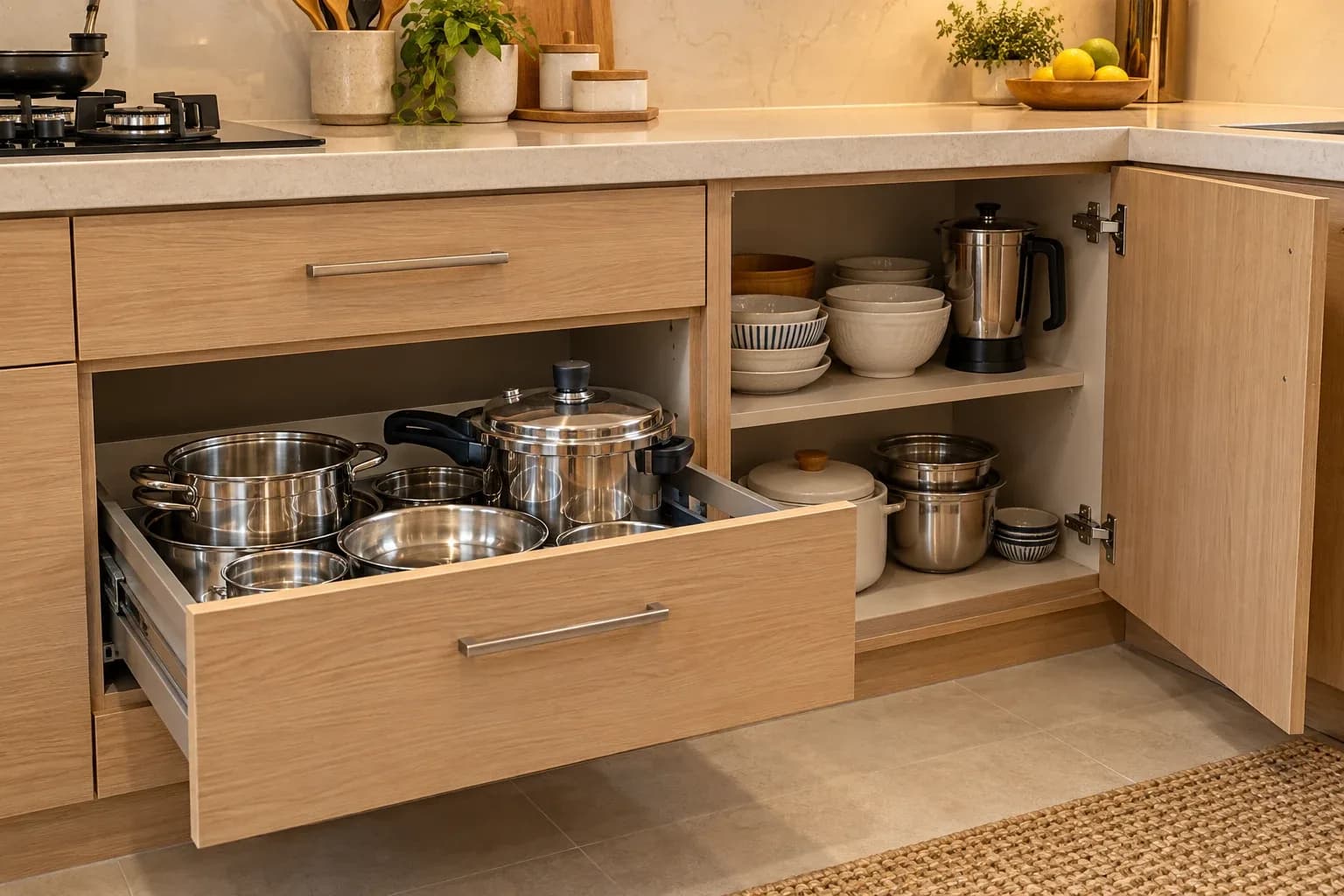
| Drawers | Fixed shelves | |
|---|---|---|
| Access | Contents move towards you; check extension type. | Rear items may need the front row moved. |
| Bulky items | Must fit the drawer's clear height and width. | Shelf spacing can suit tall or irregular items. |
| Moving parts | Runners and fixings need a suitable load rating. | Fewer mechanisms, but shelves still need support. |
| Best use | Frequently used pans, plates and utensils. | Occasional bulky items or a simpler cabinet. |
Choose around the things you reach for every day
Drawers are often easier to use for frequently handled cookware because the contents come towards you. Fixed shelves can be useful for tall or awkward items and usually involve fewer moving parts. A practical kitchen often uses both. The right balance starts with your own utensils, available cabinet sizes and budget, rather than a rule that every lower unit must be a drawer.
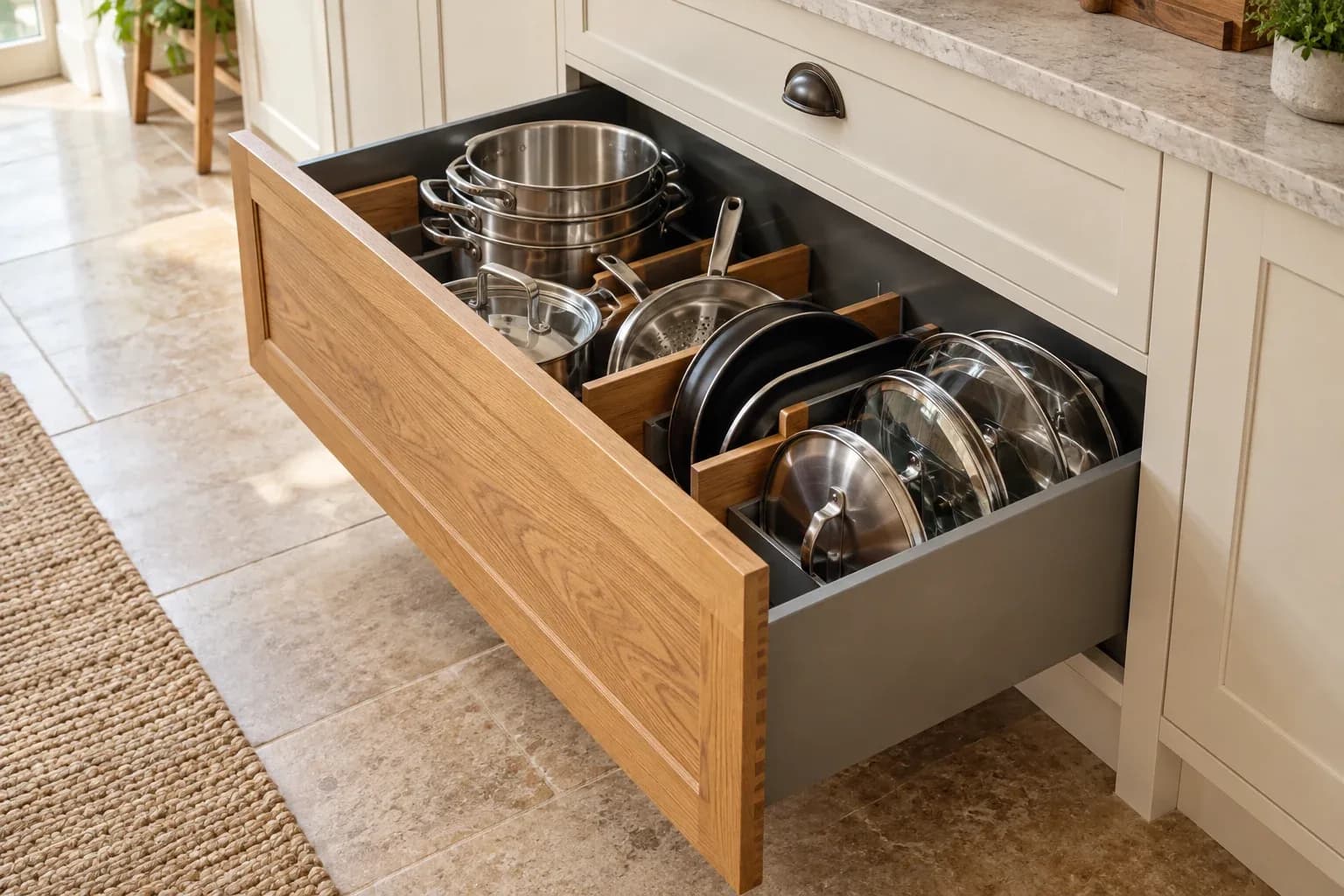
Empty a representative cupboard before finalising the drawing. Group pans with their lids, stack your steel containers as you normally use them, and measure the largest appliance that must fit inside. Include handles, lids and the clearance needed to lift things out. A cabinet's outside width is not the same as its usable internal width.
For a daily cooking zone, imagine reaching for a saucepan while another person is at the sink. A wide drawer may expose everything clearly, but it also extends into the aisle. A cupboard door creates a different obstruction. Show both movements on the plan and check nearby appliance doors as well.
Think about the person using the kitchen. Someone who finds bending and reaching uncomfortable may prefer more accessible pull-outs. Another household may need a low-cost place for bulky items used only a few times a year. Choose the arrangement that makes ordinary tasks easier for your household.
Compare access, capacity and the actual mechanism
Drawers bring the contents forward. A suitable full-extension mechanism can make the rear of the drawer easier to see and reach. That does not mean every drawer opens equally far or carries the same load. Ask for the exact runner model, extension type, load rating and compatible drawer construction. The bottom panel and fixing method also belong in the specification.
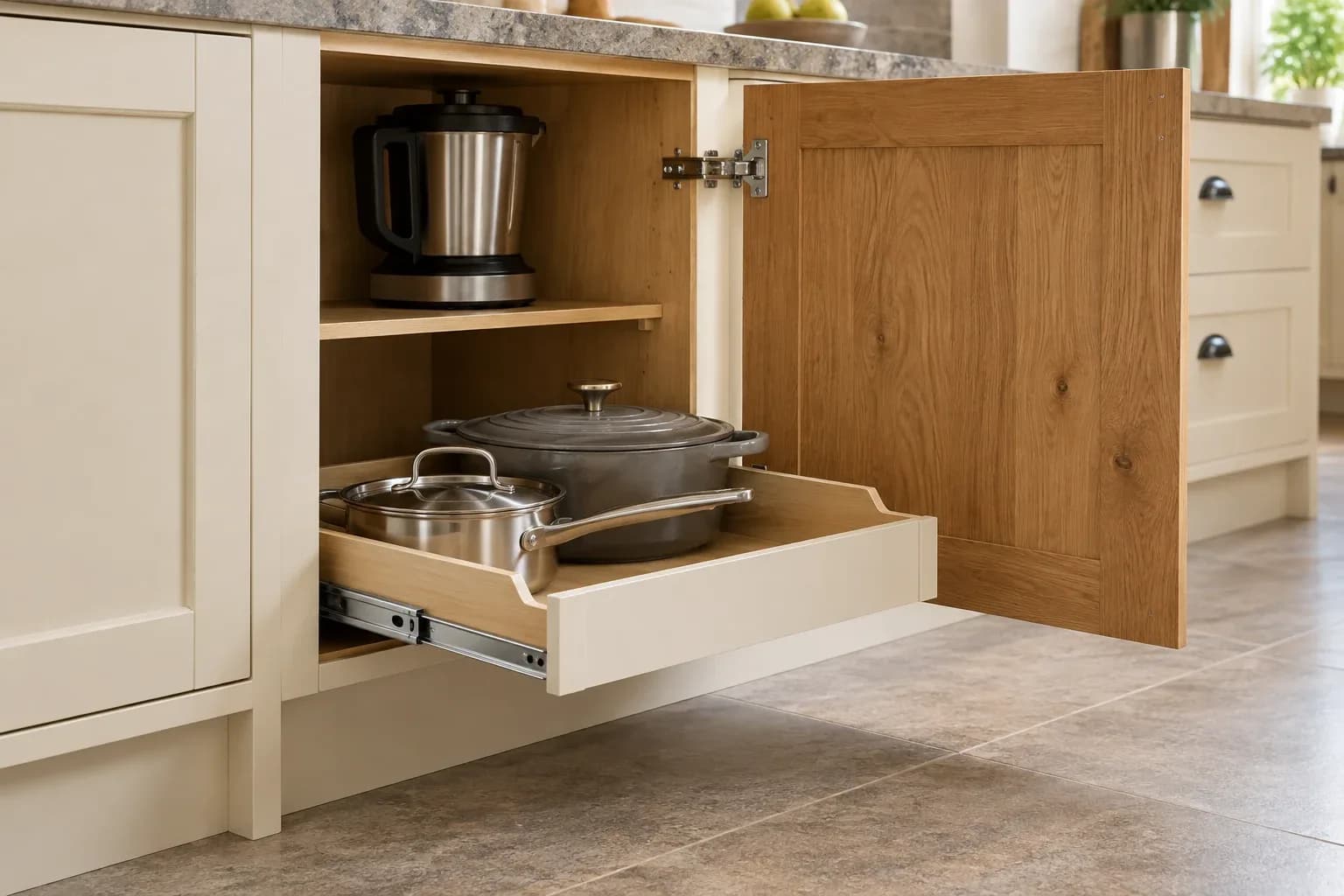
Shelves keep the box simple. An adjustable shelf can adapt to a tall appliance or a different stack of containers. However, items at the back may require moving the front row first. A deep shelf is not genuinely useful if the things you need are hidden behind something you dislike lifting.
Internal pull-outs offer a third option. These sit behind a cupboard door, keeping a continuous front while bringing stored items out. Try the opening sequence: you may need to open the door sufficiently before extending a tray. The hardware, hinges and door clearance need to work together, particularly beside a wall.
Blum's runner-system overview distinguishes extension types and load classes across its products. Use that as a reminder to compare models, not as a universal rating for any drawer. Ask the fabricator to demonstrate the proposed arrangement with a realistic load before you approve it.
Check tall bottles, plate stacks and handles against the internal height. Drawer sides, rails, partitions and runners all occupy space. A visually deep front does not guarantee the clear height needed by your largest vessel.
Spend where access matters most
Start with a few well-placed drawers near preparation and cooking areas, then decide where shelves remain sensible. A shallow cutlery drawer does a different job from a deep pan drawer. Avoid making every drawer the same depth merely to produce even lines on the outside. The exterior rhythm can still look calm while the internal organisation follows the contents.
Under the sink, plumbing and service access often shape the cabinet. Do not copy a standard pan-drawer arrangement into that space without a detailed design. Leave the fittings accessible and confirm any specialised under-sink system with the installer.
Compare two quotations for the same cabinet run: one with your preferred drawers and one with a mixed arrangement. Ask for the board, finish, edge treatment, handles, runner model, organisers, fitting and taxes to be itemised. A basic shelf price and a fully accessorised drawer price are not equivalent comparisons. Our quote checklist helps make the scope visible.
For a refined appearance, align the main fronts and limit unnecessary decorative breaks. Choose the finish from a physical sample and make sure the edge treatment belongs to that product. You can compare acrylic and laminate finishes separately from the storage mechanism.
Before handover, open every drawer and door, check for collisions and ask how to remove and refit the drawer for cleaning. Keep the hardware model details with your invoice so that future adjustments and spare-part enquiries start with the correct product.
Once the drawer and shelf layout is settled, shortlist 1 mm decorative laminates or wood-look cabinet finishes for the visible fronts. A laminate listed as 1 mm adds a decorative surface; specify the supporting board and the complete drawer construction separately. Bring a marked kitchen plan showing daily cookware, proposed drawer widths and shelf locations to Hinch in Hafeezpet, Hyderabad 500085, and check that your shortlisted finish samples are available before visiting.
Questions people ask us
Should all lower cabinets be drawers?
Not necessarily. Use drawers where access is valuable and shelves where they suit bulky or occasional items. Check plumbing, aisle clearance and budget before deciding.
Can drawers hold heavy pots?
Only within the rating of the specified system and its approved construction. Include the drawer's own weight when the manufacturer's rating requires it.
Do drawers always hold more than shelves?
No. Hardware and drawer sides use space. Compare usable internal dimensions and the arrangement of your actual cookware.
Are internal pull-outs the same as drawers?
They may use similar mechanisms but sit behind an outer door. Test the extra opening step and the clearance needed to extend them.
Can I add drawers to existing cupboards?
Sometimes. The cabinet condition, dimensions and hardware clearances need an installer assessment before a conversion is quoted.
Where should I spend first?
Prioritise the places you access most often, such as daily pans or cutlery, then compare the benefit of additional drawers elsewhere.
Shop these categories
Keep reading
- IdeasTwo-tone kitchen cabinets: how do you choose a combination that feels balanced?
Choose one finish to carry most of the kitchen and give the second a clear place to begin and end.
- CompareFlat slab vs Shaker cabinet doors: which suits an everyday kitchen?
Choose slab doors if you want broad, uninterrupted surfaces and a quick wipe across each front. Choose Shaker if you like the shadow around a recessed panel enough to take a little extra care at its lower corners. Both styles can have handles; the profile and the opening method are separate decisions.
- CompareKitchen island vs peninsula: which layout works better in a compact home?
A peninsula earns its place when attaching one end frees up a useful passage or makes everyday seating possible. An island earns its place when people can use the routes around it, even with a stool occupied and the fridge open. Test both in your own room before deciding.
- GuidesHow do you verify plywood quality before it disappears under laminate?
Verify two different things: the identity of the material delivered and the condition of the particular pieces going into your furniture. An invoice can help with the first. It cannot explain a loose layer in the panel in front of you.
- CareUneven cabinet-door gaps: is it a hinge adjustment or a fitting problem?
A gap that changes from top to bottom is a clue, not a diagnosis. Before turning a screw, establish whether one door is out of line, several units are misaligned, or the door itself will not lie flat.
- GuidesCabinet refacing or replacement: when is keeping the old kitchen worth it?
Keep the cabinet boxes if they are dry, firm and arranged the way you cook.