
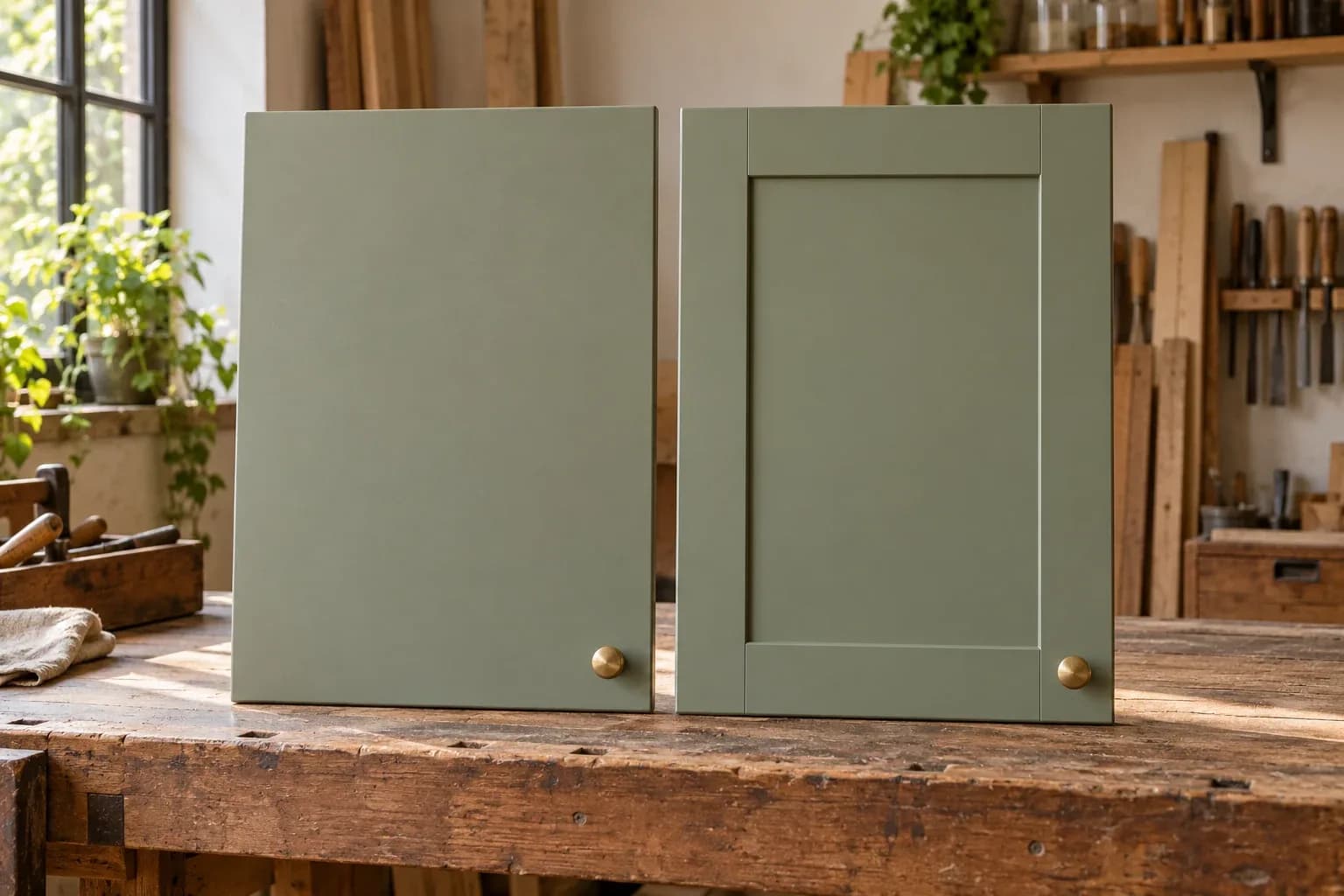
| Flat slab | Shaker | |
|---|---|---|
| Where will my cloth catch? | Mostly at handles and outside edges | Also along the frame-to-panel junction |
| What gives the front character? | Colour, grain and the gaps between fronts | Frame width, centre panel and shadow |
| What should I check on a small drawer? | Grain alignment and pull position | Space left inside the rails for the pull |
| Can I choose a conventional handle? | Yes, with a suitable fixing detail | Yes, with the position checked on the profile |
Look at the smallest drawer, not just the biggest door
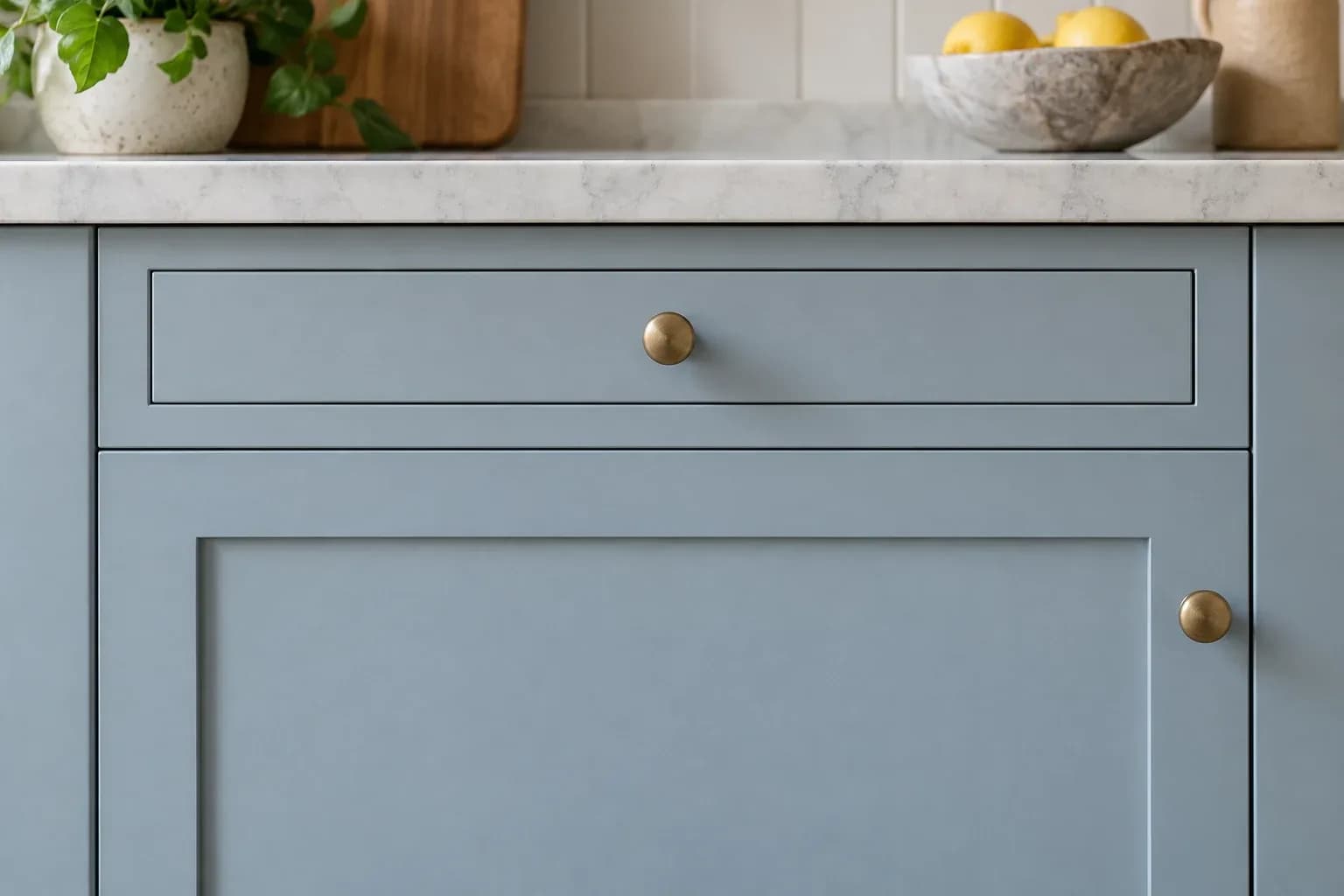
A slab front presents one plane to the room. A Shaker front has a centre panel framed by rails and stiles: the horizontal and vertical pieces around it. Some versions are assembled from separate parts; others are machined to resemble them. A slim Shaker uses a narrower border. Those differences disappear surprisingly easily in a wide kitchen rendering.
Ask to see the proposed profile on your shallow cutlery drawer as well as a full-height shutter. On a small drawer, two wide rails can leave a narrow strip of centre panel. The handle may look squeezed even though it looked fine on the display door. A maker might offer a plain top drawer with framed fronts below. Look at that arrangement from the other end of the kitchen before deciding whether the change feels deliberate.
With slab doors, the pattern comes from the material and the joints between doors. If a wood grain is the main detail, sketch its direction across a stack of drawers. A lovely sample can still look disjointed when its most prominent lines restart at each front.
Use the cleaning test that matches your cooking
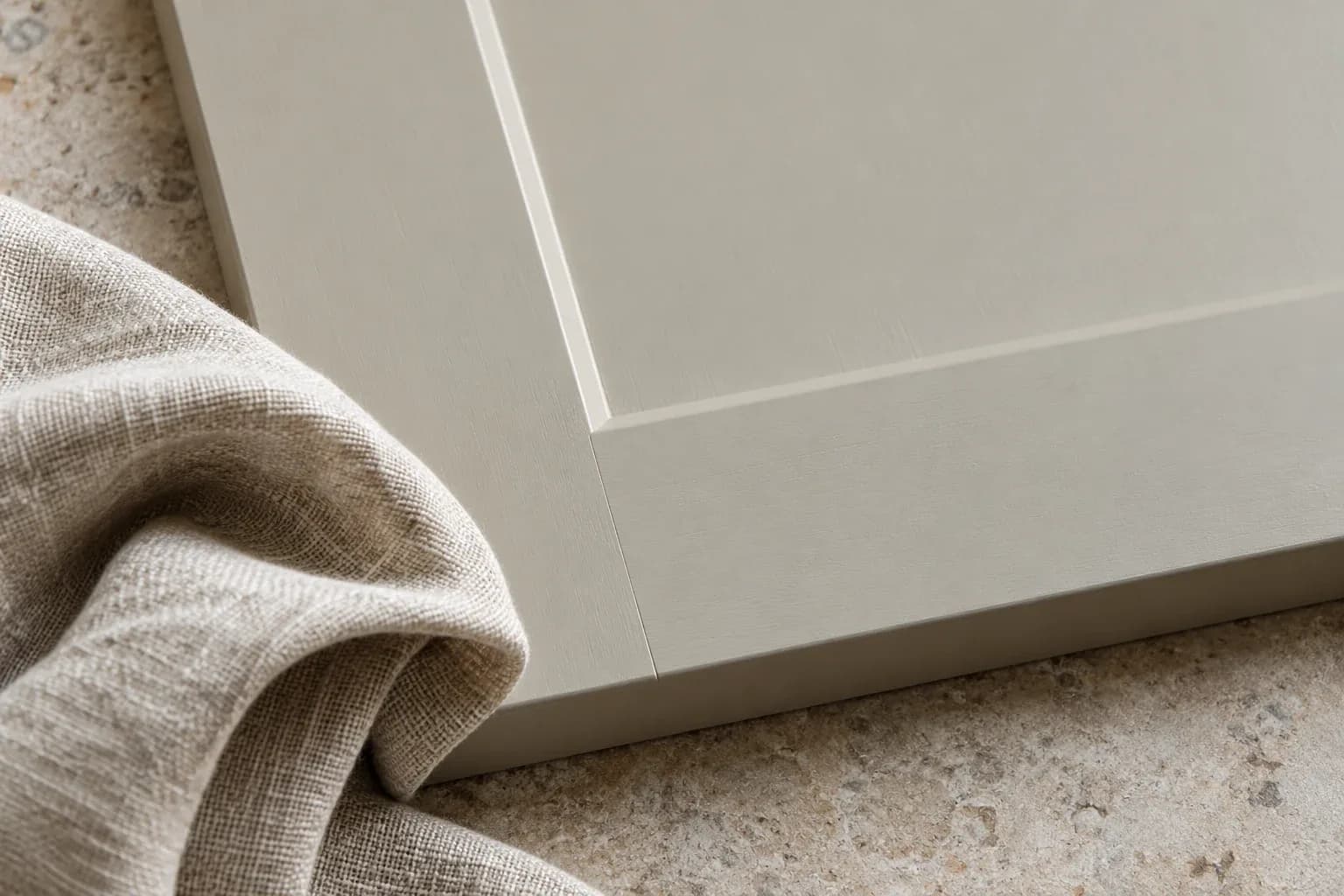
Try following the lower inside corner of a sample Shaker door with a clean, dry cloth. That small return is where you will change direction when wiping flour or cooking splashes. A sharply stepped profile and a gently sloped one feel different under your fingers. Slim does not automatically mean easier: a narrow recess can be harder to reach than a wider, shallow one.
On the slab sample, look along the face in side light. A smooth front has no frame ledge, but the colour and sheen still affect which fingerprints you notice. Set a handle against the sample and touch the door where your hand naturally lands. A pale matt slab with a pull is a different daily experience from a dark glossy slab you press to open.
Think about location as well as style. A door beside the hob may be wiped most evenings, while a tall crockery cabinet across the room sees little grease. If you enjoy framed doors but dislike cleaning ledges, the least-used run is a sensible place to try them.
Order the construction and the profile separately
The word Shaker tells you about the silhouette, not what the door is made from. Slab is equally broad. Ask what is underneath the surface, how the edge is finished and how the supplier expects that exact product to be cleaned. Compare the back and the corners of the samples; the impressive front is the one surface everyone remembers to show you.
Get a quotation for the same cabinet drawing in both styles. Include the same hinges, pulls, exposed ends and drawer count. If one option costs more, ask whether the difference is the door construction, a finish change, machining or the handle arrangement. That lets you keep the detail you value and drop a change you never wanted.
Before signing off, view a sample against your actual floor and counter. Move the sample between a bright wall and a shaded corner. If you still prefer the shadow line of the framed door in both places, that is a better reason to buy it than a prediction about what will be fashionable in five years.
On the drawing, note whether a dimension refers to the finished shutter or just its decorative skin. A 1 mm laminate is not a 1 mm door; a slim frame dimension describes something else again. Ask for the finished section at the edge of the exact door you plan to buy.
Once you choose a door profile, compare opening methods in Handleless vs handled kitchen cabinets: which is more practical?.
Questions people ask us
Does a slab door have to be handleless?
No. A knob or bar pull can be fitted if the door construction permits it. Try the opening action separately from the look.
Is slim Shaker a good compromise?
It can be if you like a subtle border. See an actual drawer; reducing the rail width also changes the proportions and the room available for hardware.
Which style lasts longer?
Profile alone cannot establish lifespan. The core, finish, edge treatment, hinges and exposure to water all matter. Compare the exact door specifications.
Can I mix flat drawers with framed doors?
Yes. Repeat the rule across a whole run so it looks intentional, and check that the colour and sheen match where the two fronts meet.
Which works better in a small kitchen?
Slabs keep a busy elevation quiet. A restrained Shaker can work equally well if the frame sizes look balanced on the smaller fronts.
Shop these categories
Keep reading
- IdeasTwo-tone kitchen cabinets: how do you choose a combination that feels balanced?
Choose one finish to carry most of the kitchen and give the second a clear place to begin and end.
- CompareKitchen island vs peninsula: which layout works better in a compact home?
A peninsula earns its place when attaching one end frees up a useful passage or makes everyday seating possible. An island earns its place when people can use the routes around it, even with a stool occupied and the fridge open. Test both in your own room before deciding.
- GuidesHow do you verify plywood quality before it disappears under laminate?
Verify two different things: the identity of the material delivered and the condition of the particular pieces going into your furniture. An invoice can help with the first. It cannot explain a loose layer in the panel in front of you.
- CareUneven cabinet-door gaps: is it a hinge adjustment or a fitting problem?
A gap that changes from top to bottom is a clue, not a diagnosis. Before turning a screw, establish whether one door is out of line, several units are misaligned, or the door itself will not lie flat.
- GuidesCabinet refacing or replacement: when is keeping the old kitchen worth it?
Keep the cabinet boxes if they are dry, firm and arranged the way you cook.
- CompareFloating vs floor-standing bathroom vanity: what should decide your choice?
A floating vanity works when the wall can take the specified load and the plumbing fits behind the storage. A floor-standing unit can offer more room below the basin and conceal low pipework. Decide from a measured view of your wall and a drawer opened to its full depth.