
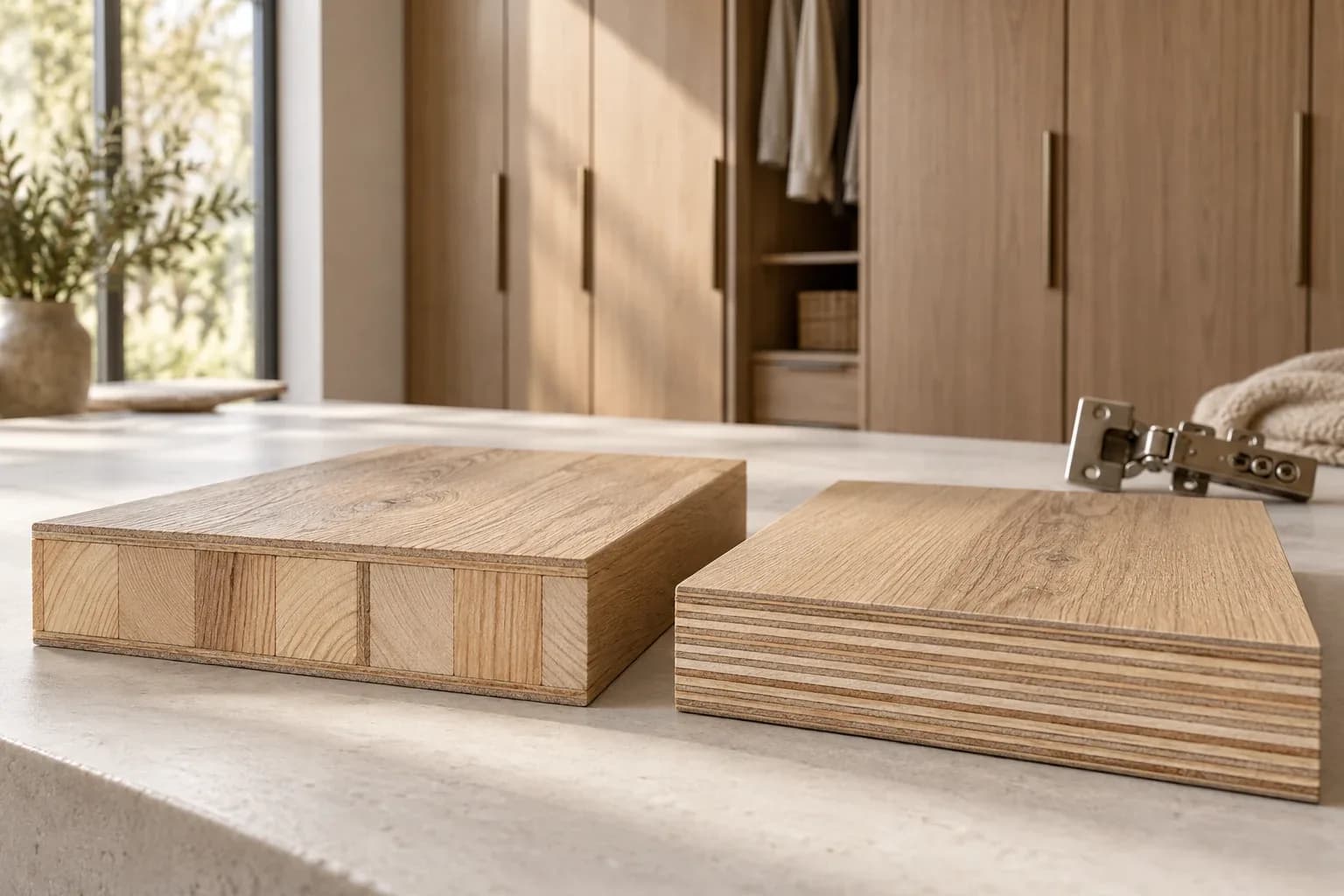
| Blockboard | Plywood | |
|---|---|---|
| Construction | Typically uses timber strips in the core with face layers. | Uses bonded veneer layers, generally arranged with alternating grain directions. |
| What to compare | Exact product, core quality, grade, thickness and suitability for the proposed shutter. | Exact product, grade, thickness and suitability for the proposed shutter. |
| Tall-door planning | Confirm permitted dimensions, facing construction and the hardware schedule. | Confirm permitted dimensions, facing construction and the hardware schedule. |
| Decision rule | Choose an approved assembly, rather than assuming every blockboard resists bending. | Choose an approved assembly, rather than assuming thickness alone prevents bending. |
Specify the whole shutter, not just the board name
For a tall hinged wardrobe door, neither the word blockboard nor the word plywood is a guarantee against bending. The product grade, panel dimensions, storage conditions, finishes and hardware all form part of the decision. Start with the finished door size and ask the fabricator to explain the construction they recommend for that size.
Blockboard generally has a timber-strip core faced with layers, while plywood uses bonded veneers. Those descriptions explain the broad construction; they do not tell you the quality of a particular sheet. Compare identifiable products with technical information and clear invoices. Avoid a quotation that says only premium board or waterproof wood.
Ask whether the supplier supports the exact application, including any unusually tall or wide shutter. A large uninterrupted door can look elegant, but dividing a wardrobe into a main door and a separate overhead section may be worth discussing when the proposed dimensions create a demanding assembly. The best choice is the one your fabricator can specify and install properly.
Reduce the causes of distortion before installation
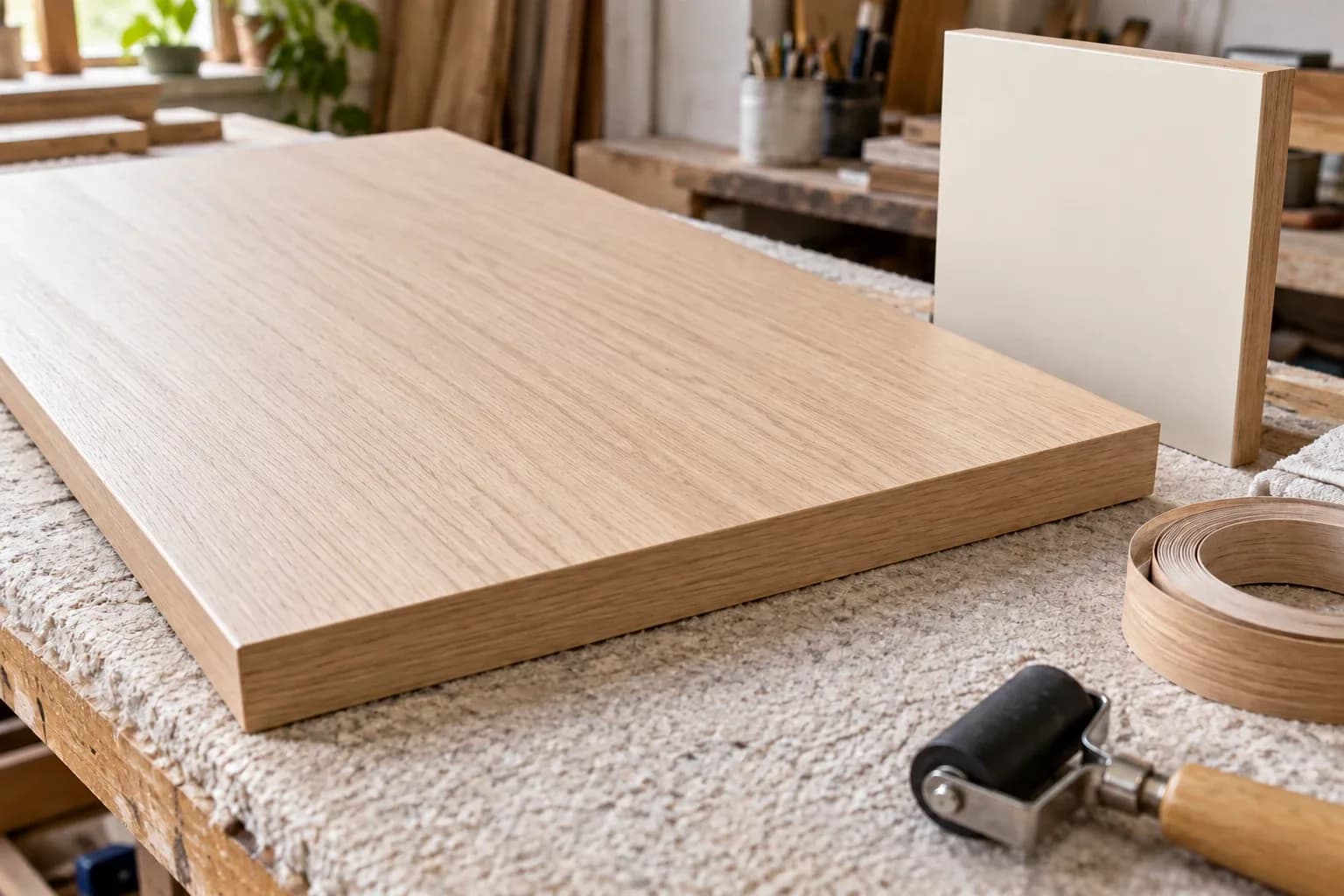
Inspect sheets and finished shutters for visible bowing or damage before installation. Ask how panels will be stored and protected during work, particularly in a home where wet trades are still underway. Installing a visibly distorted shutter and hoping the hinges will pull it flat is a poor starting point.
Discuss both faces of the door. The decorative face, reverse face, adhesive system and finishing sequence should follow the panel and surfacing suppliers' guidance. Do not assume that any inexpensive backing sheet will provide an appropriate balance. Edge treatment also needs to be part of the specification, including edges that are less visible once the wardrobe is fitted.
Room conditions matter too. Find and resolve damp walls or leaks before fitting the unit. A material sold for improved moisture resistance should not be treated as permission to enclose an active damp problem. Keep records of the exact board and finish supplied so that a later concern can be investigated.
If an existing door appears bent, distinguish panel distortion from loose fixings, a misaligned cabinet or an adjustment issue. The repair should follow the cause. Additional hinges are not a universal cure for an unsuitable or damaged panel.
Match the hinges and quote to the finished door
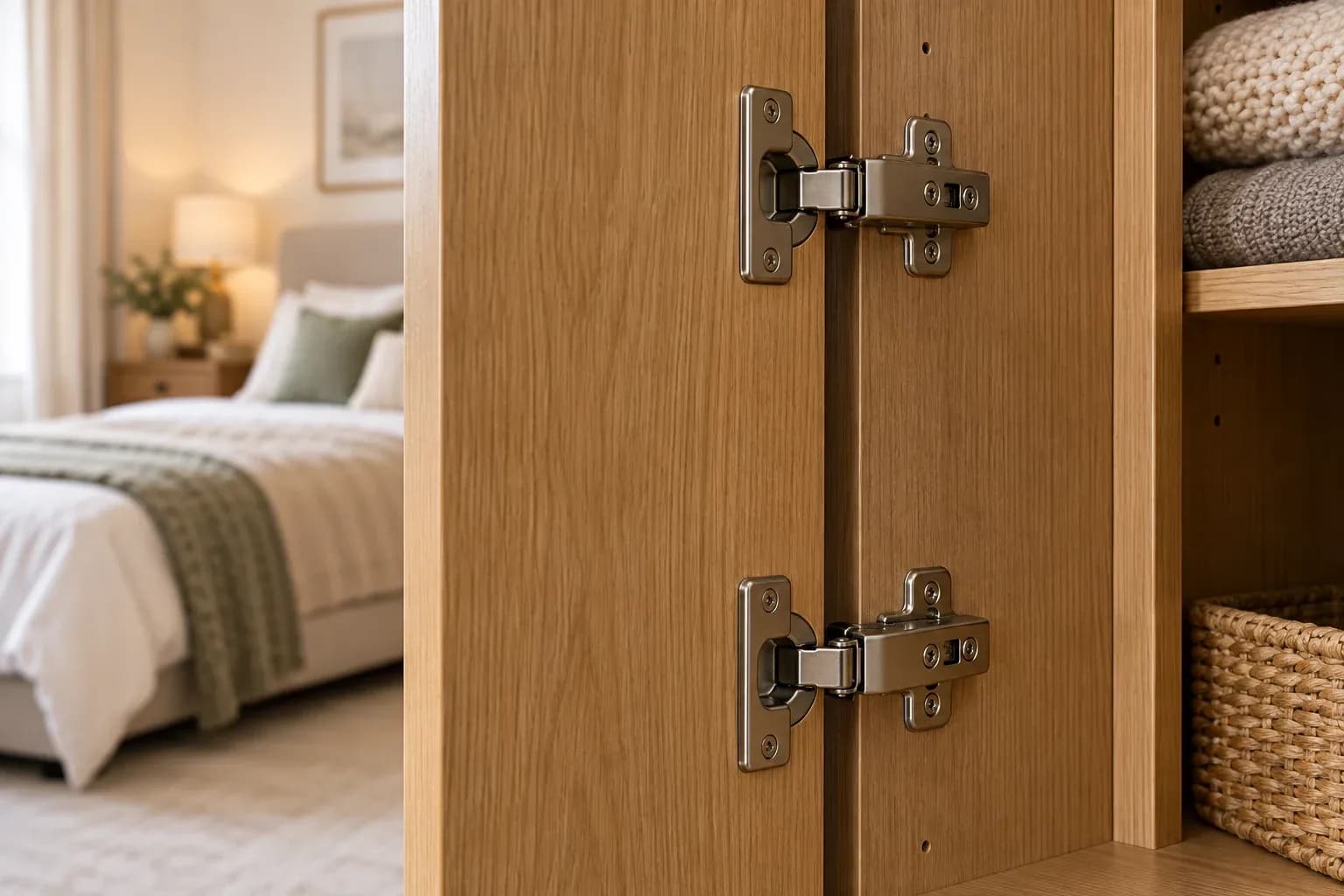
Give the hardware supplier the finished door height, width, weight and material. Hettich's hinge planning guidance uses these factors when assessing the number of hinges. Do not copy a hinge count from another wardrobe simply because its doors look similar.
Ask for the hinge model, mounting arrangement and fixing requirements in the quote. Decorative laminates, mirrors, handles and other additions contribute to the finished assembly. If those details change after the hardware is selected, ask the fabricator to review the selection again. Check that the door opens without striking an adjacent wall, drawer or light fitting.
Compare quotations with the same finished dimensions, board product, front and reverse finishes, edge treatment and hardware. Include installation and adjustment responsibilities. A cheaper sheet price can be misleading when the rest of the shutter construction differs.
Browse 1 mm wardrobe laminates for surface options and cabinet hinges for hardware planning. A 1 mm laminate is the decorative layer, not the shutter's full thickness. At Hinch in Hafeezpet, Hyderabad 500085, bring the dimensioned drawing and ask for material options against the proposed construction.
For the broader finish decision, read laminate vs veneer.
Questions people ask us
Is blockboard always better for a tall wardrobe shutter?
No. It can be a suitable choice, but the exact product, dimensions, construction and hardware must support the application. Avoid choosing from the generic material name alone.
Can plywood wardrobe doors bend?
They can distort under unsuitable conditions or construction. Product quality, panel dimensions, moisture exposure and the finished assembly all deserve attention.
Will using a thicker board prevent bending?
Thickness alone does not settle the design. It also changes weight, so the fabricator must assess the panel and hardware together.
How many hinges does a tall wardrobe door need?
Use the selected hinge manufacturer's guidance for the actual height, width, weight and material. There is no single count that suits every tall door.
Can hinges straighten a warped shutter?
Hinge adjustment can address alignment, but it is not a reliable cure for a distorted panel. Have the installer identify the cause before adding hardware.
Should the back of the shutter be finished too?
Ask for a complete facing and edge specification that follows the product suppliers' guidance. Do not leave the reverse construction as an unspecified afterthought.
Shop these categories
Keep reading
- CareWhy does a wardrobe smell damp, and how can you prevent moisture build-up?
Start with where the smell is strongest and when it returns. Damp clothes packed on one shelf, condensation against a cool wall and a plumbing leak behind a fitted wardrobe need different responses. A new board or a fragrance insert cannot remove the source of moisture.
- AnswersWhy does wardrobe laminate look different from the showroom sample?
Lighting, viewing angle and the size of the finished wardrobe can change how a laminate looks. Check the material and the room before deciding it is the wrong finish.
- AnswersHow to identify wood veneer or laminate before refinishing
Check the surface material without damaging it before sanding, staining or repainting furniture.
- IdeasTwo-tone kitchen cabinets: how do you choose a combination that feels balanced?
Choose one finish to carry most of the kitchen and give the second a clear place to begin and end.
- CompareFlat slab vs Shaker cabinet doors: which suits an everyday kitchen?
Choose slab doors if you want broad, uninterrupted surfaces and a quick wipe across each front. Choose Shaker if you like the shadow around a recessed panel enough to take a little extra care at its lower corners. Both styles can have handles; the profile and the opening method are separate decisions.
- CompareKitchen island vs peninsula: which layout works better in a compact home?
A peninsula earns its place when attaching one end frees up a useful passage or makes everyday seating possible. An island earns its place when people can use the routes around it, even with a stool occupied and the fridge open. Test both in your own room before deciding.