

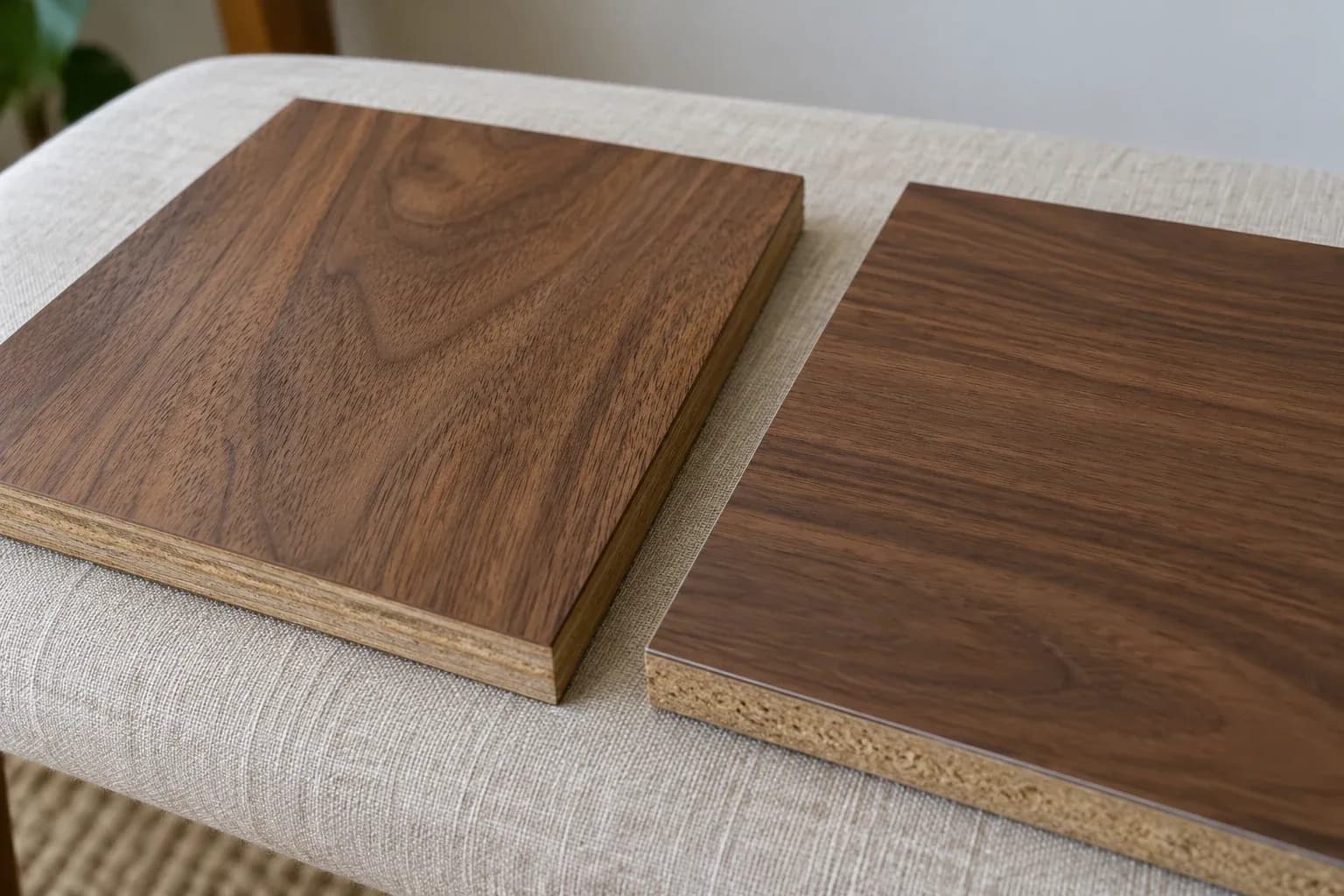
Start with the invoice or product label, then inspect grain and an already exposed edge. Veneer is a thin wood face; decorative laminate usually has a printed resin-based surface. Texture alone is unreliable. Identify the face separately from the core, and avoid sanding until the material and remaining surface thickness are confirmed.
Check records first, then inspect without damage
Look for an invoice, furniture specification, spare offcut or label inside the cabinet. Ask the original maker for the surface product code, the supporting board and the finish applied over it. These are separate pieces of information. A quotation that says only “engineered wood” describes too little to decide whether you can stain the visible face.
If the invoice names a Merino or Greenlam product, keep the full design code and grade rather than relying on the brand name. A carpenter may also have used different finishes on the front, back and edges. Record which part you are assessing: a drawer front, a tabletop and its edge strip need not share the same construction.
Examine the grain in good light. Natural veneer can show variation and real wood pores. Exact repeating features across unrelated panels can suggest a printed surface, but matching alone is not proof: real veneer can be deliberately matched, and reconstituted veneer may be regular. Embossed laminate can also imitate texture. Treat appearance as a clue to combine with documentation, not a definitive test.
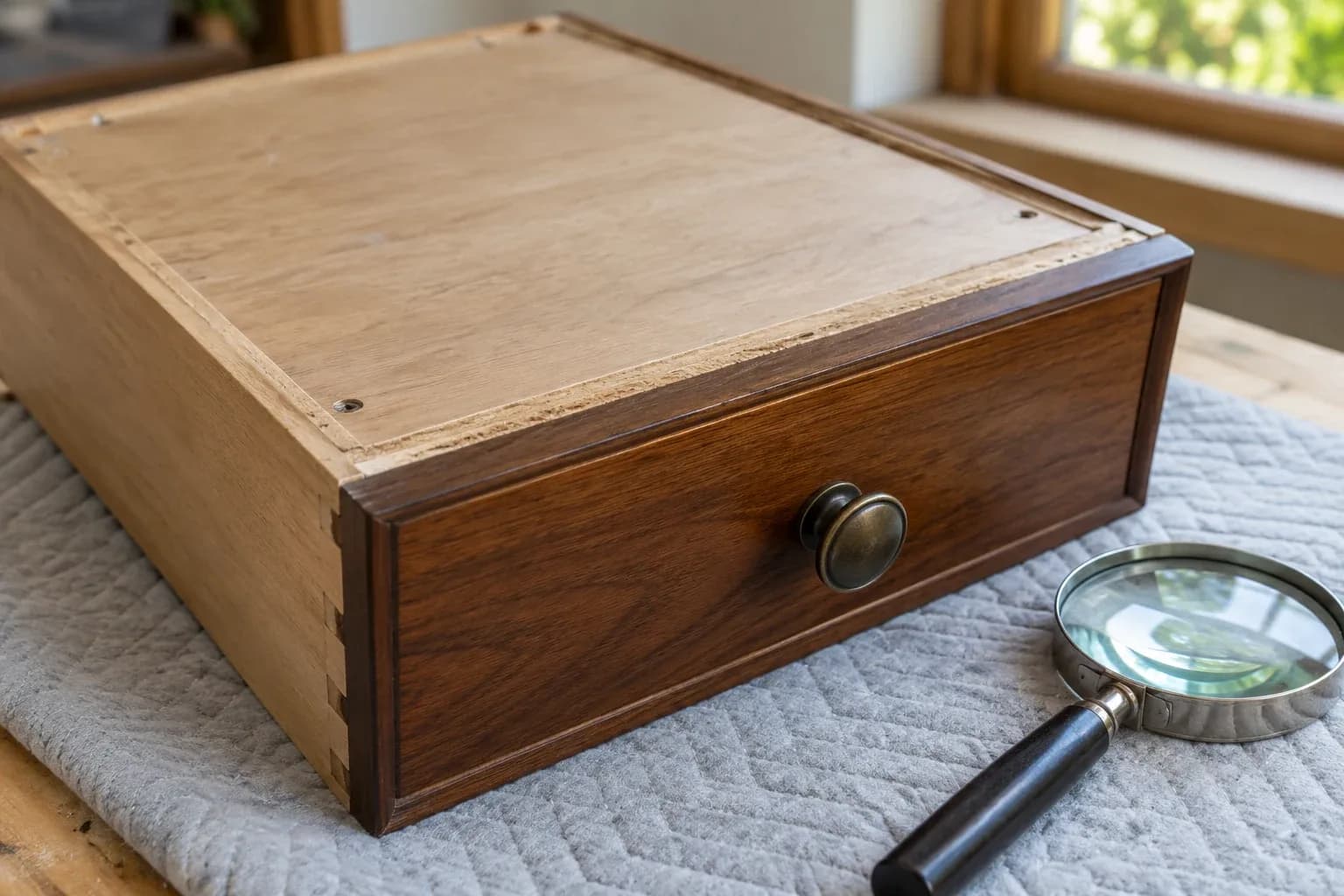
Inspect an edge that is already visible, such as an unfinished underside or existing damage. A thin wood face suggests veneer; a decorative layer over a paper-based laminate build-up suggests laminate. Edge banding can conceal both. Do not pry off a sound edge strip or create a chip to get an answer. Photograph what is visible and ask a furniture repairer to assess uncertain construction.
Seeing plywood, MDF or particleboard beneath a surface does not settle the question. Either veneer or laminate can be bonded to a supporting board. Likewise, a solid timber edge does not prove that the whole tabletop is solid timber. Check the face, edge and core independently before choosing a repair method.
Archidply’s veneer identification guide is a useful reference for material documentation and visible construction. Use it alongside the exact product specification. A general illustration cannot confirm what a previous owner or fabricator installed in your furniture.
Let the confirmed material decide the next step
For confirmed wood veneer, the next question is whether enough sound face remains for the proposed work. Veneer is a thin wood layer, and previous sanding may have reduced it further. Knowing the original thickness does not reveal what remains today. Ask a refinisher to assess worn corners, loose patches and previous repairs before agreeing to remove the existing finish. Do not assume the same sanding routine used on solid timber is appropriate.
The Natural Veneers refinishing guide highlights the need for care with thin veneer. The practical decision for an old piece is whether cleaning, local finish repair, professional refinishing or replacement best preserves the surface. A small area of lifting face needs its bond assessed before cosmetic treatment.
For confirmed decorative laminate, do not sand in search of wood grain. Removing the decorative face damages the design rather than exposing a timber surface ready for ordinary penetrating wood stain. A 1 mm laminate is not a 1 mm sanding allowance. If you want a new colour, discuss a compatible paint system or replacement facing with the supplier or finisher, and assess adhesion and core condition first.
If the furniture has a flexible wrap, acrylic face, specialised veneer laminate or an unidentified coating, stop trying to force it into a two-material answer. Ask for the exact construction. Water-drop, solvent, heat and scratch experiments can alter a finish without providing a reliable identification, so avoid using them as casual household tests.
Before requesting a quote, take one overall photograph and close-ups of the face, an existing exposed edge, any label and each damaged area. State whether the goal is to restore the existing appearance, change the colour or replace a damaged facing. Ask the professional to identify the surface and explain the proposed method before quoting for sanding or stripping.
Our laminate versus veneer comparison covers choosing between the materials for new work. For an existing piece, identification and condition come first. If the face remains sound and you are only dealing with ordinary marks, start with the material’s care instructions rather than committing to refinishing.
Questions people ask us
Does a wood-grain surface mean the furniture has real veneer?
No. Printed and embossed laminates can imitate wood grain and texture. Combine visual clues with the product specification and an already exposed edge.
If I can see MDF underneath, is the face laminate?
Not necessarily. Both veneer and laminate can be applied to MDF and other supporting boards. Identify the visible face separately from the core.
Can I sand veneer like solid wood?
No. The face may be thin or previously sanded. Have its condition and remaining thickness assessed before removing a finish, especially at edges and damaged areas.
Can laminate be sanded and stained to reveal wood?
Ordinary decorative laminate has no natural wood face to reveal. Sanding through its printed layer damages the design. Consider an appropriate coating or replacement only after confirming the material and condition.
What should I do when labels and visual clues are inconclusive?
Keep the surface intact. Send a repairer clear photographs of the whole piece, existing edges, labels and damage, and ask for a material identification before choosing sanding, stripping or refinishing.
Shop these categories
Keep reading
- IdeasTwo-tone kitchen cabinets: how do you choose a combination that feels balanced?
Choose one finish to carry most of the kitchen and give the second a clear place to begin and end.
- CompareFlat slab vs Shaker cabinet doors: which suits an everyday kitchen?
Choose slab doors if you want broad, uninterrupted surfaces and a quick wipe across each front. Choose Shaker if you like the shadow around a recessed panel enough to take a little extra care at its lower corners. Both styles can have handles; the profile and the opening method are separate decisions.
- CompareKitchen island vs peninsula: which layout works better in a compact home?
A peninsula earns its place when attaching one end frees up a useful passage or makes everyday seating possible. An island earns its place when people can use the routes around it, even with a stool occupied and the fridge open. Test both in your own room before deciding.
- GuidesHow do you verify plywood quality before it disappears under laminate?
Verify two different things: the identity of the material delivered and the condition of the particular pieces going into your furniture. An invoice can help with the first. It cannot explain a loose layer in the panel in front of you.
- GuidesCabinet refacing or replacement: when is keeping the old kitchen worth it?
Keep the cabinet boxes if they are dry, firm and arranged the way you cook.
- CompareFloating vs floor-standing bathroom vanity: what should decide your choice?
A floating vanity works when the wall can take the specified load and the plumbing fits behind the storage. A floor-standing unit can offer more room below the basin and conceal low pipework. Decide from a measured view of your wall and a drawer opened to its full depth.