
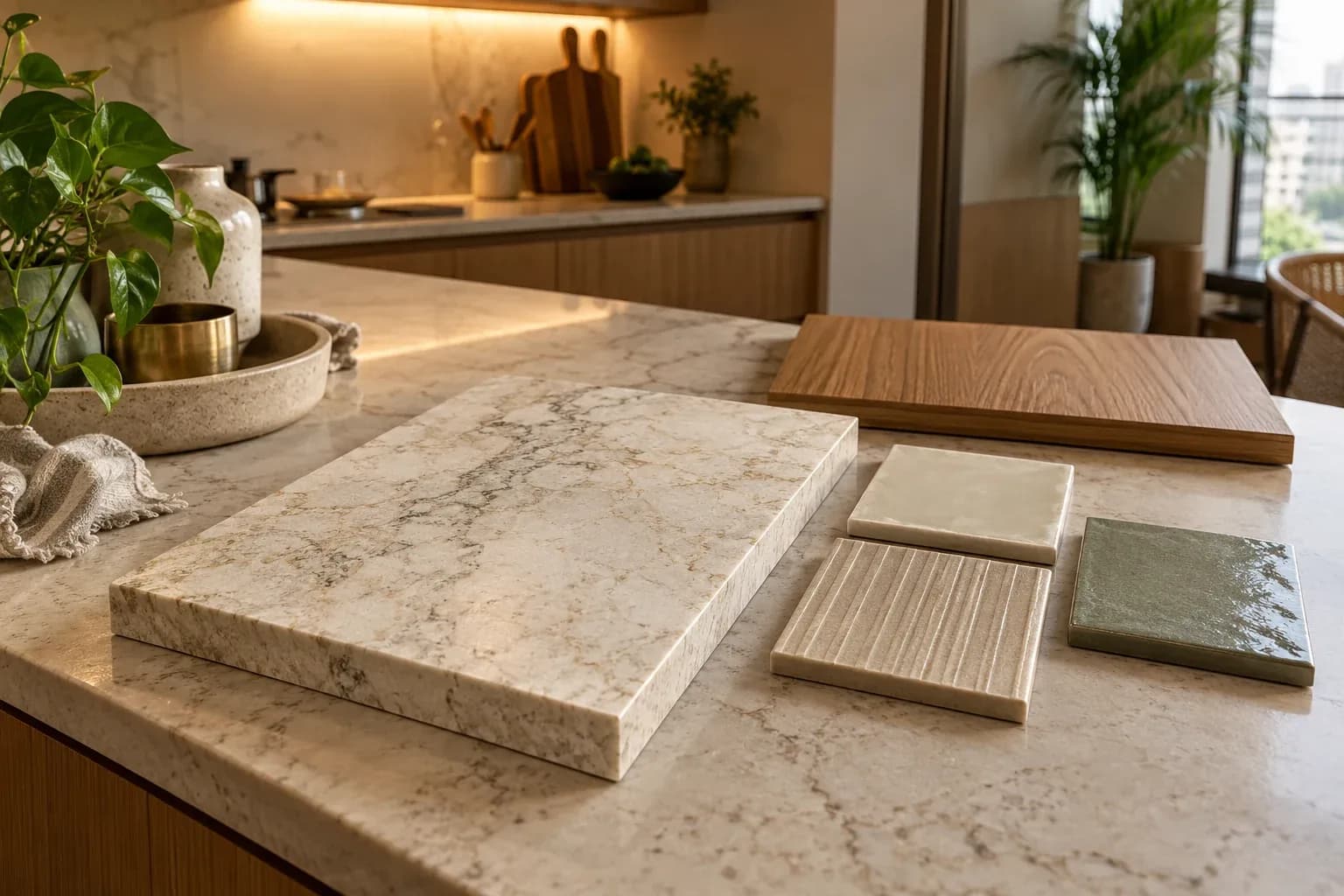
Practical guidance
When both surfaces are new, choosing the worktop first often gives the backsplash a clear material to respond to. If one finish is already fixed, begin there. The goal is to approve the complete group together and avoid ordering two strong patterns independently.
## Identify the fixed elements
List the cabinet fronts, floor, worktop and wall finish, marking what will stay. A retained granite counter gives the backsplash a different starting point from a kitchen where the slab has not been selected. Take physical samples of the permanent finishes into the comparison.
Do not rely on separate phone photographs for colour matching. Camera processing and screen brightness can shift undertones. Place samples in their intended orientation, with worktop flat and backsplash upright, so their lighting and relationship resemble the completed room.
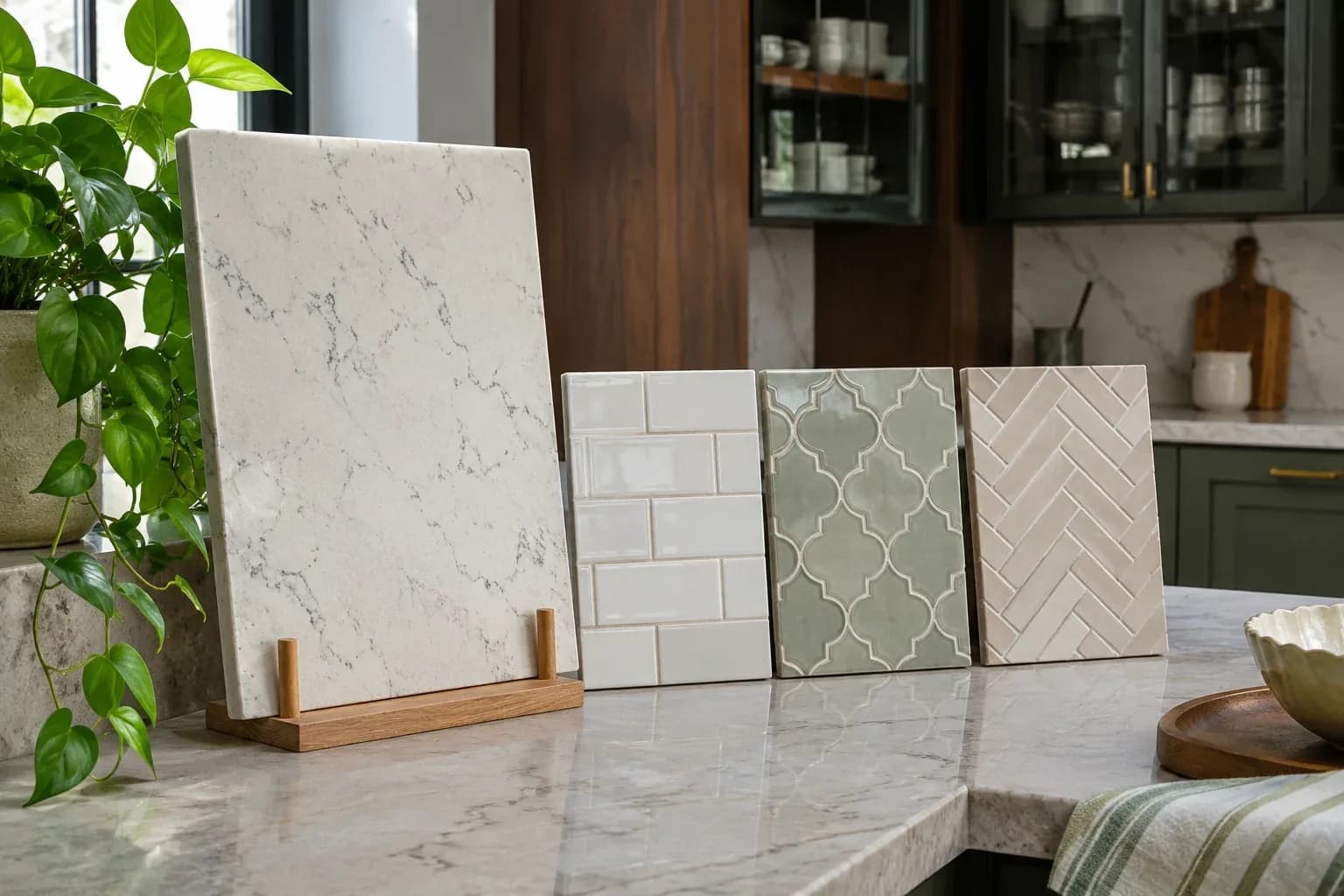
Give the room a clear visual lead
If the worktop has strong movement, begin with quieter wall options. If the wall tile is the feature you love, compare less busy worktops. This is a way to test balance, not a rule that only one pattern is permitted.
Review the full slab image and a sufficiently large tile arrangement. Add grout colour and any visible trim to the sample group. A pale tile can change character substantially when a contrasting grout grid is introduced, while a small countertop chip can hide a vein that dominates the full run.
Separate selection order from installation order
You may choose both materials together even though the worktop is installed before the backsplash. Have the installer confirm the sequence for the actual construction. Final setting-out should account for the finished worktop level and any appliance or window details.
Record all material codes and junction decisions before committing. If one surface changes late, revisit the group instead of assuming the other remains a perfect match. Keep the signed samples and layout photographs so the fitting team can identify what was approved.
## A practical check before you decide
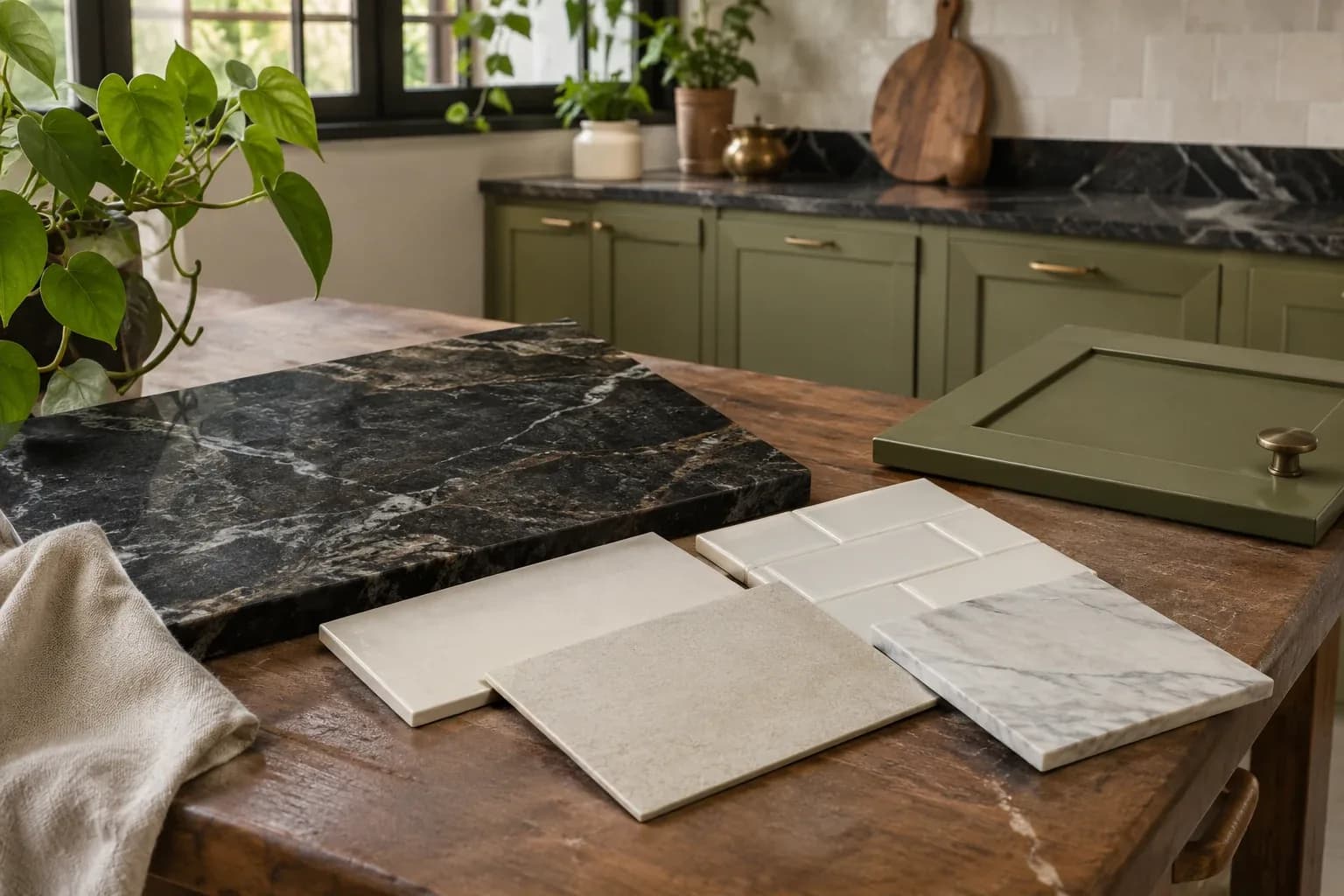
Make one sample board containing the cabinet face, worktop, backsplash, grout and handle. View it near the kitchen window and under evening task lighting. Remove one visually strong element at a time if the group feels crowded, then approve the final combination in writing.
## Approve the junction as well as the colours
The countertop edge, backsplash return and cabinet end meet in the same small area. Draw that junction before ordering finishes. Thickness affects the depth of a window return, the relationship to sockets and the visible edge at the end of the run. Cosentino lists Silestone in 12 mm, 20 mm and 30 mm; the product specification provides a concrete example of the section information to request. Confirm the actual product and wall build-up with the installer rather than treating a colour swatch as a construction detail.
## Compare a complete group in the room
Place the worktop sample horizontally and the wall sample vertically. Add the cabinet front, handle and grout or trim sample. Look at the group near the kitchen window and under the intended evening lights. Note which surface attracts attention first and whether that is the effect you want. Photograph the arrangement as a record, but use the physical samples for the final colour decision.
If the worktop has large movement, include a full-slab image beside the samples. For patterned tile, arrange enough pieces to understand the repeat and joint grid. Try a quieter alternative for one surface if the combination feels crowded. A change to one element can be easier to judge when every other element stays in place.
## Freeze the decision before fabrication
Record product codes, finish, orientation and the approved junction drawing. Ask which items need final site measurement and which orders can safely proceed. If the chosen worktop becomes unavailable, review the backsplash and cabinet group again before accepting a substitute. Keep selection approval separate from the fitting schedule: materials can be chosen together while the installers still need a coordinated sequence and finished reference levels.
Questions people ask us
Must the worktop always be chosen first?
No. Start with the fixed or most important material and coordinate the remaining choices.
Can I choose the backsplash before the cabinets?
You can, provided the whole finish group is reviewed before orders are final.
Should grout be selected at the same time?
Yes. It is part of the visible wall composition.
Is a phone rendering enough?
Use it to explore a scheme, then approve physical samples and material references.
What if the chosen slab becomes unavailable?
Recheck its replacement against every committed finish before accepting it.