
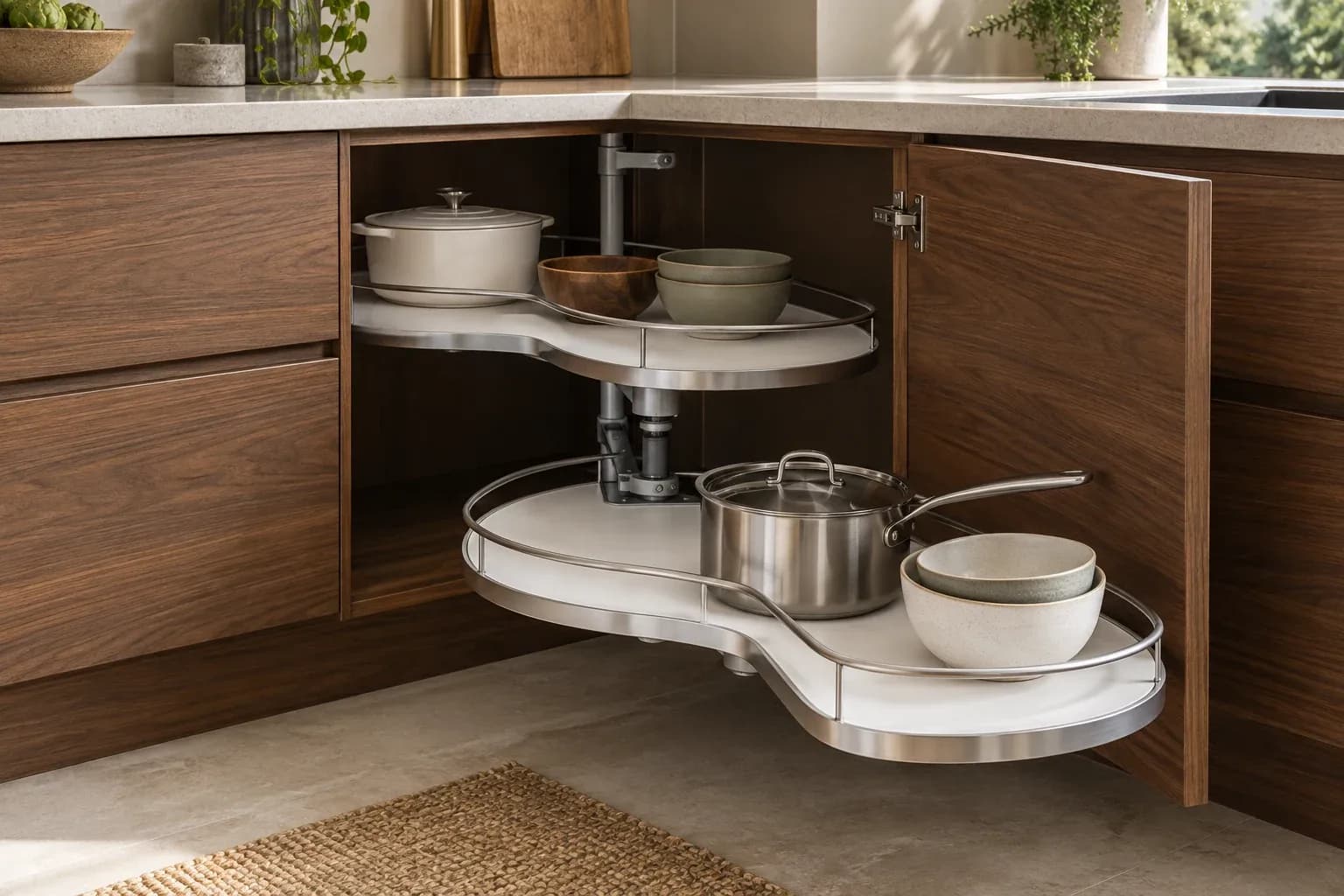
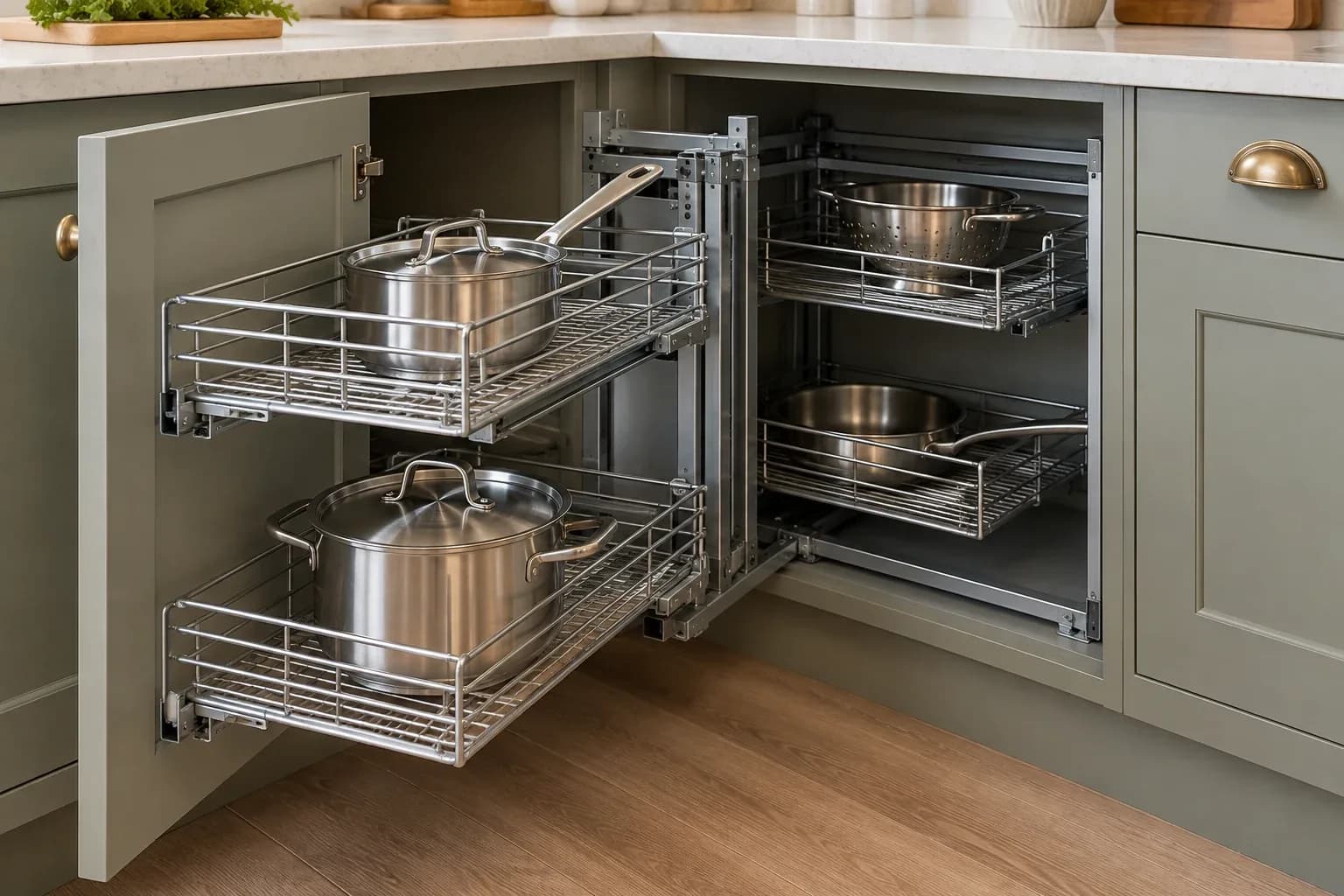
| Magic corner pull-out | Carousel or swing-out shelves | |
|---|---|---|
| Movement | Linked baskets move in a defined sequence. | Shelves rotate or swing, depending on the system. |
| Usable space | Frames and baskets occupy part of the cabinet. | Shelf shape and mechanism affect usable area. |
| Fit | Check handedness, opening and internal clearances. | Check the exact cabinet and door requirements. |
| Decision | Test access with your cookware and rated load. | Test access with your cookware and rated load. |
Compare the actual fittings, not just their names
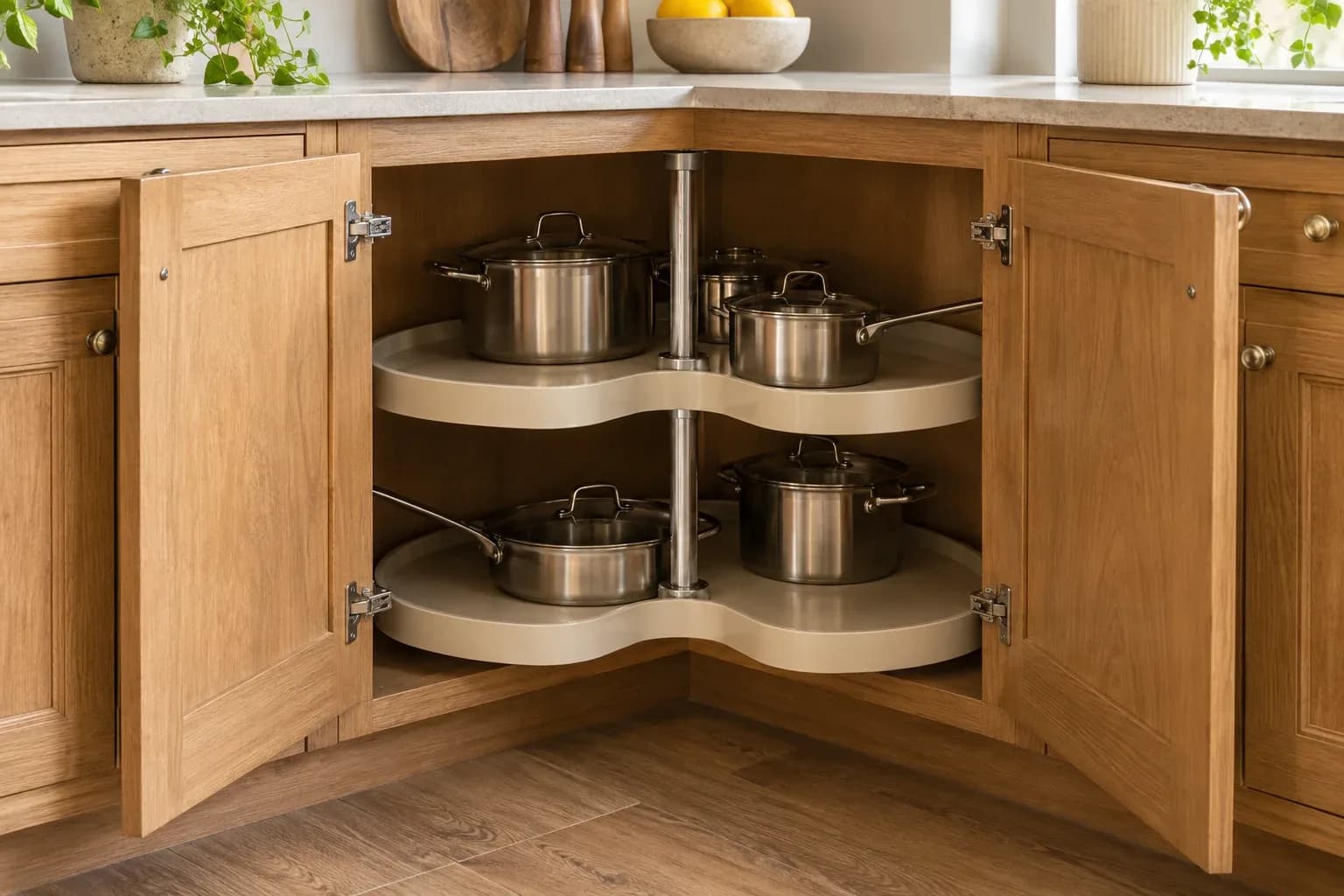
A magic corner system can bring baskets out of a blind corner in a sequence. A carousel rotates within the corner, while a swing-out shelf moves along a different path. Retailers sometimes use these names loosely. Ask to see the exact model and opening movement before deciding which one suits your kitchen.
The goal is not to fill every empty centimetre. It is to make the things you store accessible without awkward lifting or dismantling a stack. A fitting can use less of the cabinet's theoretical volume yet make more of the contents usable. Equally, an expensive mechanism can be disappointing if its trays are too small for your vessels.
Take measurements of your largest pot, pressure cooker and mixing bowl. Include handles and lids. Try placing similar objects on the demonstration shelves rather than judging an almost empty display. Ask whether those objects can be lifted out without striking the door, neighbouring handle or the shelf above.
Start with the corner itself. A blind corner, a diagonal cabinet and two runs meeting at right angles may need different solutions. Do not approve the cabinet box first and assume that a favourite accessory will fit afterwards. The cabinet and mechanism should be planned together.
Check the dimensions that determine everyday use
Ask for the required cabinet width, internal depth, door opening and installation height from the manufacturer's drawing. Confirm whether the fitting is left-handed or right-handed and how far the moving shelves extend into the room. Hinges, pipes and electrical points can reduce the space that looks available on the plan.
Load ratings are model-specific. A figure for one branded swing-out unit is not a rating for every corner mechanism. Häfele's LeMans II product listing is one example of a manufacturer stating capacity per basket. Use the documentation for the exact locally supplied model and configuration in your quotation.
Test the sequence with a realistic load. Can you open the door far enough in the finished layout? Do you need to pull one tray before reaching the next? Does a pot handle interfere with the frame? Can the person who usually cooks manage the motion comfortably? These questions matter more than a smooth demonstration with no utensils inside.
A simple rotating shelf, a swing-out shelf and a linked basket system also leave different unused areas around their mechanisms. Ask to see the internal arrangement from above. Compare usable tray shapes, height between shelves and the effort of lifting items, rather than comparing the exterior cabinet area.
Think about cleaning and service access. Find out how the trays are removed, where crumbs may collect and who can adjust the fitting. Keep moving components accessible instead of boxing them in behind decorative panels.
Decide whether the corner needs a mechanism at all
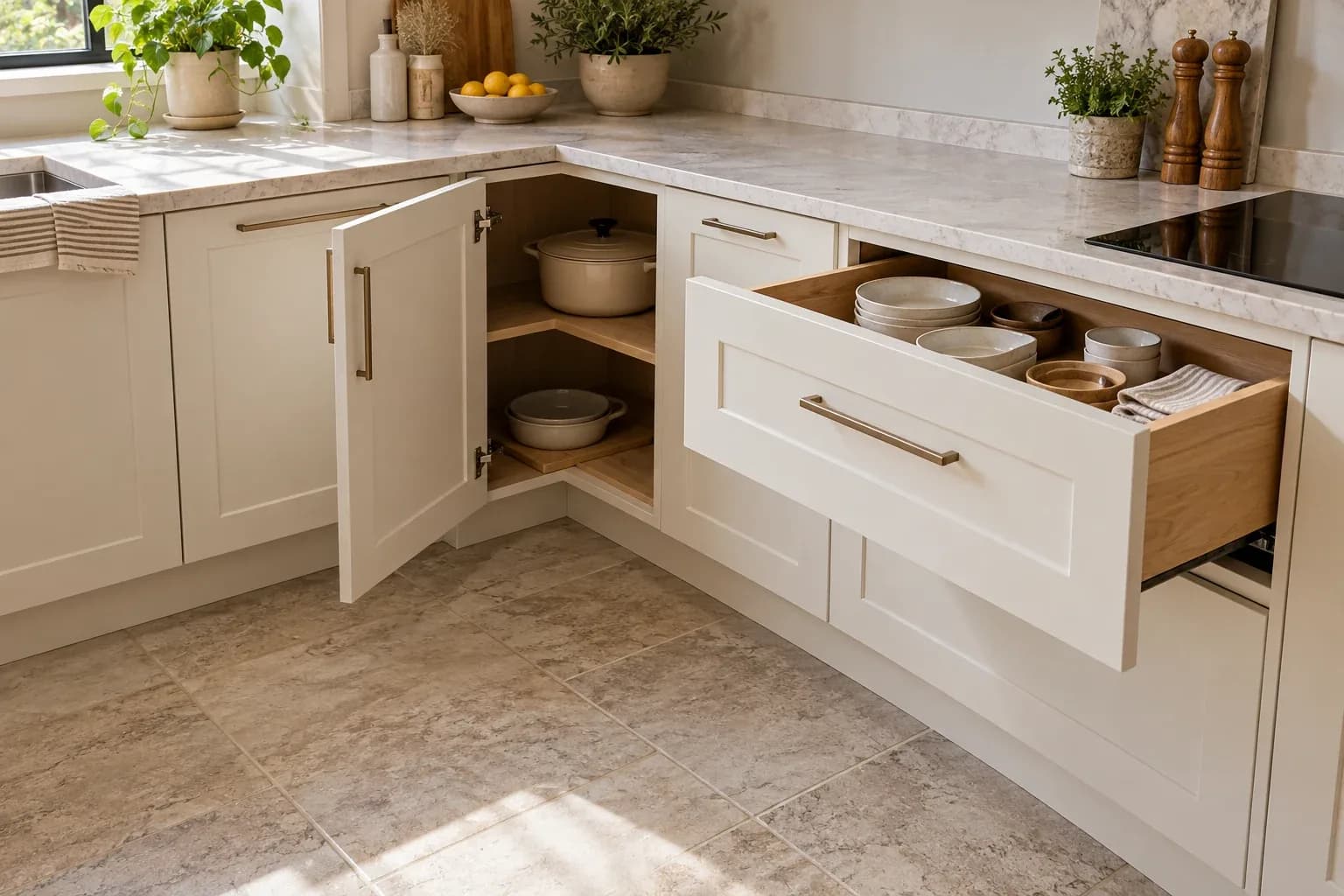
If you rarely use what goes in the corner, a simple shelf arrangement may be adequate. In some layouts, leaving a small inaccessible corner unused allows wider, more practical drawers on the adjacent runs. That is worth comparing on a drawing rather than treating every unused pocket as a design failure.
A mechanism makes more sense when it serves a clear storage need and the adjacent layout supports its motion. It may be less useful where the opening is narrow, services obstruct the interior or the trays cannot hold the household's larger vessels. Ask the designer to show at least one alternative before committing.
Compare complete quotations. Include the cabinet box, fronts, hinges, accessory model, mounting components, installation and any finishing panels. Ask what support is available for the supplied system and keep its model details with the invoice. A brand name alone does not identify the correct spare part.
Browse Hardware and Cabinet Finishes separately while planning. If the door uses a 1 mm decorative laminate, that specifies the face sheet rather than the whole shutter. Take the corner drawing, opening direction and utensil measurements to Hinch Hafeezpet in Hyderabad 500085, and confirm the relevant display or product information is available before visiting.
Choose the fitting that makes your stored items easy to reach within the verified limits of the cabinet. If neither option improves that daily task enough to justify the cost and complexity, a simpler corner can still be a good kitchen decision.
For the cabinet material decision, read BWP plywood vs HDHMR for kitchen cabinets.
Questions people ask us
Does a magic corner use all the available space?
No. Baskets, frames and movement clearances occupy space. Compare usable capacity and access, not just the outside cabinet dimensions.
Is a carousel the same as a swing-out shelf?
No. A carousel rotates, while a swing-out system follows its own path. Ask to see the exact proposed model operate.
Which fitting holds heavier cookware?
That depends on the model and configuration. Use the manufacturer's rating for each shelf or basket and confirm the installation requirements.
Can either system be fitted later?
Sometimes, but the existing cabinet opening, dimensions, hinges and services may prevent it. Have an installer check before ordering.
What measurements should I bring?
Bring the corner plan, internal cabinet dimensions, door opening and the sizes of your largest vessels, including handles and lids.
Is leaving the corner unused wasteful?
Not necessarily. It can be sensible if it allows better adjacent storage. Compare the entire kitchen's usable storage before deciding.
Shop these categories
Keep reading
- IdeasTwo-tone kitchen cabinets: how do you choose a combination that feels balanced?
Choose one finish to carry most of the kitchen and give the second a clear place to begin and end.
- CompareFlat slab vs Shaker cabinet doors: which suits an everyday kitchen?
Choose slab doors if you want broad, uninterrupted surfaces and a quick wipe across each front. Choose Shaker if you like the shadow around a recessed panel enough to take a little extra care at its lower corners. Both styles can have handles; the profile and the opening method are separate decisions.
- CompareKitchen island vs peninsula: which layout works better in a compact home?
A peninsula earns its place when attaching one end frees up a useful passage or makes everyday seating possible. An island earns its place when people can use the routes around it, even with a stool occupied and the fridge open. Test both in your own room before deciding.
- GuidesHow do you verify plywood quality before it disappears under laminate?
Verify two different things: the identity of the material delivered and the condition of the particular pieces going into your furniture. An invoice can help with the first. It cannot explain a loose layer in the panel in front of you.
- CareUneven cabinet-door gaps: is it a hinge adjustment or a fitting problem?
A gap that changes from top to bottom is a clue, not a diagnosis. Before turning a screw, establish whether one door is out of line, several units are misaligned, or the door itself will not lie flat.
- GuidesCabinet refacing or replacement: when is keeping the old kitchen worth it?
Keep the cabinet boxes if they are dry, firm and arranged the way you cook.