
| 0.8 mm laminate | 1 mm laminate | |
|---|---|---|
| Nominal thickness | 0.8 mm; confirm the exact product and tolerance. | 1.0 mm; nominally 0.2 mm thicker. |
| Application | Check the manufacturer’s grade and intended use. | Check the manufacturer’s grade and intended use. |
| Performance | Do not assume all thinner sheets are inner liners. | Do not assume thickness alone guarantees better wear resistance. |
| Cost comparison | Compare dimensions, quantity, finish and fabrication scope. | Compare the same scope and ask what the upgrade changes. |
Thickness is one part of the specification
A 1 mm laminate is nominally 0.2 mm thicker than a 0.8 mm laminate. That number does not tell you, on its own, which sheet is right for your kitchen or wardrobe. Compare the product grade, finish, intended application and installation instructions before accepting a recommendation.
It is tempting to turn thickness into a simple rule: thinner for interiors, thicker for everything outside. In practice, the manufacturer's specification matters. Greenlam's technical library includes separate documents for 0.8 mm and 1.0 mm high-pressure laminates, including an HGS 0.80 mm listing. That is a reason to check the grade, not to assume that every thin sheet is merely an inner liner.
Ask the supplier to identify what is actually being quoted. Two sheets with different thicknesses may also belong to different collections, have different finishes or serve different uses. If all those details change together, you are comparing two products, not conducting a clean comparison of thickness.
Browse 0.8 mm decorative laminates and 1 mm decorative laminates, then take the exact codes to your fabricator. A category is a useful starting filter, not an approval for a particular installation.
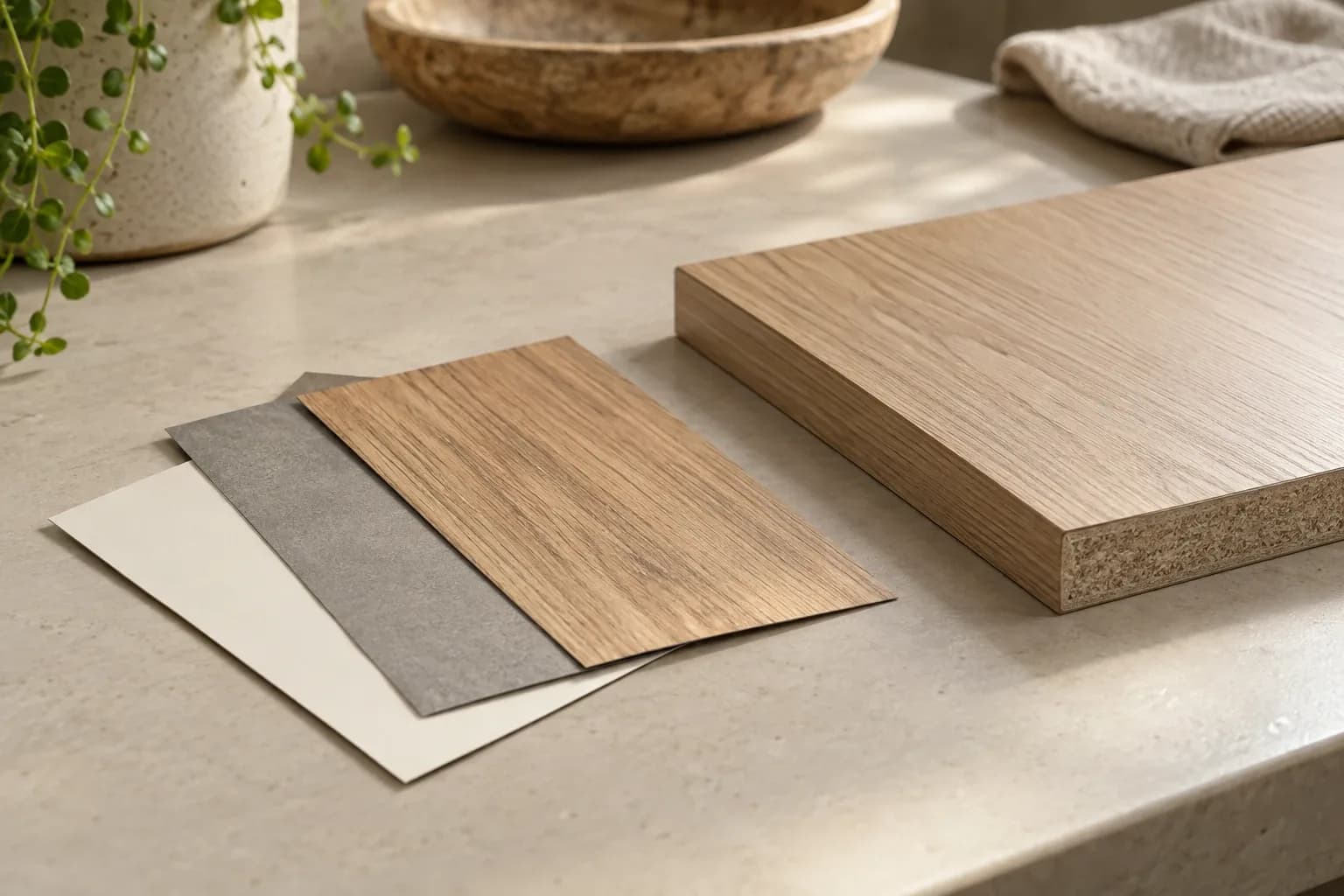
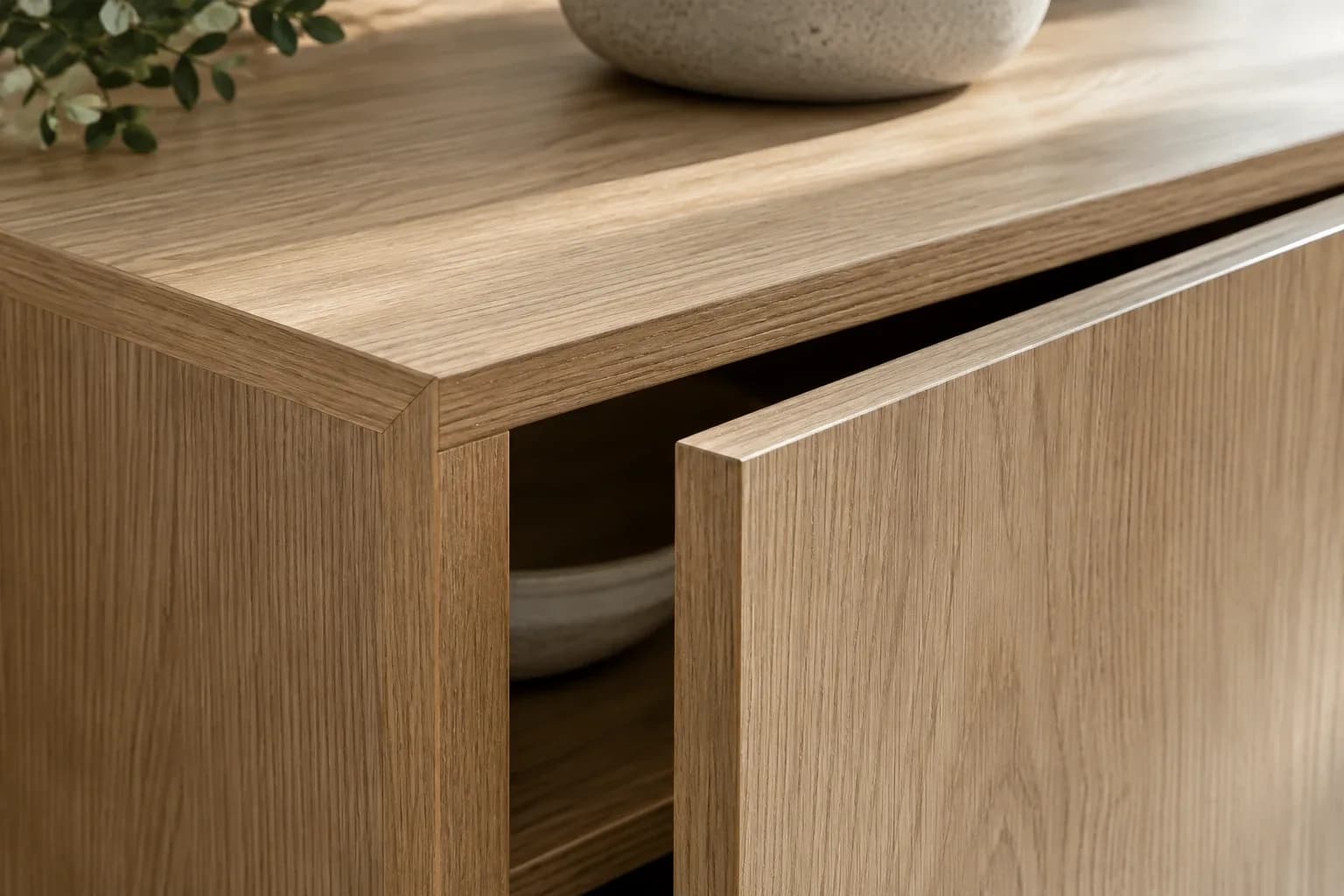
Compare the whole surface
Start with the job. Write down whether the sheet is for a cabinet door, an inner face, a desk surface or a decorative wall panel. Ask which product grade the manufacturer supports for that application. Where surfaces face heat, moisture or heavy wear, describe those conditions instead of asking only for the thicker option.
Check the supporting board. A decorative laminate face is not the same as the structural board underneath it. Have the fabricator specify the board and the complete panel construction separately. The right sheet cannot make an unsuitable or poorly prepared substrate a good choice.
Look at both faces and the edges. Ask how the reverse face will be finished and what edge detail will be used. Inspect an assembled sample if possible. Colour continuity, the edge line and the appearance around a handle can influence how the finished furniture feels more than a thickness number in a catalogue.
Read the product-specific performance information. If scratch or stain resistance is a priority, ask for the relevant published information for the actual range. Do not infer that 25 percent more nominal thickness produces 25 percent more durability. The arithmetic describes thickness alone, not performance in a home.
Discuss fabrication before buying. Tell the installer the sheet dimensions, finish and grain direction. Ask whether their cutting and bonding process suits the product. A curved detail, a flat shutter and a worktop may need different product choices or construction methods; obtain the manufacturer's recommendation where the proposed use is unusual.
Spend where the specification earns its place
Ask for prices on the same quantities and the same scope. A low sheet price can be misleading if the required size, layout or grain direction changes the number of sheets. Include cutting allowances and the reverse-face material in the estimate. Our laminate coverage explanation shows why nominal area and usable pieces are different.
Do not agree to a blanket upgrade without asking what problem it solves. Equally, do not accept a cheaper substitution described only as “almost the same”. Ask the fabricator to record the intended application, product range, nominal thickness and reason for the choice. That gives you something concrete to approve.
For a wardrobe, you may end up with different specifications for the visible doors and the inside surfaces. That can be reasonable when each product is suitable for its role. Keep those choices on the drawing so the approved decorative sheet does not get confused with the lining.
Before the order is cut, check the delivered labels against the quotation and retain the invoice. Record any approved replacement code. If you cannot confirm the product grade or care information, resolve that gap before installation rather than relying on a thickness promise.
Reference: Greenlam technical documents and Merino laminate collections. These show why the range and its documentation should stay attached to the thickness description.
Questions people ask us
Is 1 mm laminate always better than 0.8 mm?
No. Thickness alone does not establish suitability or performance. Compare the exact grade, intended use, finish and complete installation specification.
What is the actual thickness difference?
The nominal difference is 0.2 mm. Manufacturing tolerances and the specification of the actual product should be checked in its technical documentation.
Is every 0.8 mm sheet an inner liner?
No. Do not infer the product grade from thickness alone. Ask for the manufacturer’s intended-use and technical information for the selected range.
Will the thicker sheet hide a poor board surface?
Do not use thickness as a substitute for proper substrate preparation. Ask the fabricator to follow the product’s bonding and construction requirements.
What should I compare besides the price per sheet?
Compare sheet dimensions, usable cutting layout, product grade, finish, reverse-face material, edges and the complete fabrication cost.
Shop these categories
- 1 mm Decorative Laminates
- 0.8 mm Decorative Laminates
- Wood Laminates
- Matte Finish Laminates
- Solid Colour Laminates
Keep reading
- GuidesWhich laminate brand should you choose for a modular kitchen?
A practical way to compare brands without losing sight of the kitchen you are actually building.
- PricesWhat should a laminate furniture quote include beyond sheet price?
Turn a single furniture price into a clear scope you can compare and approve.
- AreasBuying laminate sheets in Hyderabad: full sheets and smaller pieces
Know what to ask before a store visit, especially when you need less than a full sheet.
- CompareAcrylic vs laminate for kitchen cabinets: which should you choose?
Choose kitchen shutters around the finish you love, the construction behind it and the care you can live with.
- GuidesHow to choose laminate sheets for your home
A practical route from your first shortlist to the final order, with room, finish, quantity and budget checks.
- AnswersCan you use laminates over existing furniture?
Keep the furniture you like, but check the old surface before choosing its new finish.