

Practical guidance
Check refrigerator clearance with the exact model's door and drawer movements, not only its closed dimensions. A fridge can fit between panels yet still prevent a crisper from opening or hit a wall with its handle. Resolve that before cutting the cabinet enclosure.
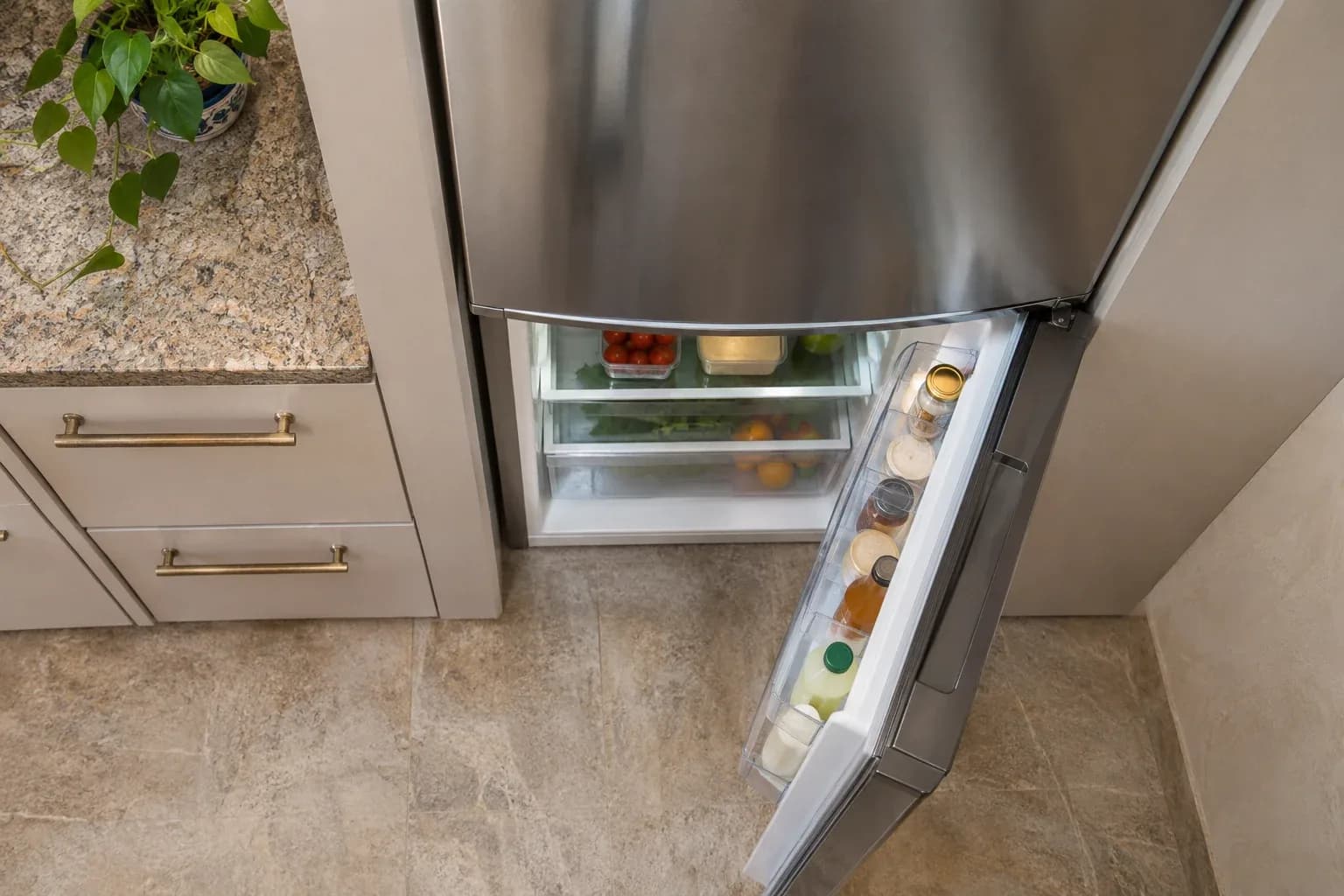
Start with the manufacturer's planning drawing
Obtain the current specification for the model you will buy. Include the body, doors, hinges, handles, ventilation and the space needed for drawers to open. The sales-page width is only one of these measurements.
Mark the neighbouring wall, pantry front, countertop projection and end panel on the plan. Check the wider door arc where an appliance sits in a recess. Some refrigerators need a greater opening angle to remove internal bins than to reach an ordinary shelf. Use the model's requirements rather than assuming a right angle is sufficient.
Mock up a normal grocery-loading session
Draw or tape the actual door travel at full size. Stand beside it with a shopping bag and open the nearest kitchen drawer. Include the route for someone walking through the room. A filler panel may be needed for movement, even when it appears to be unused space in a rendering.
Check access to the water connection, plug and controls if fitted. Ventilation openings should remain clear. Do not ask the carpenter to close a specified air gap merely to make the appliance look more built-in.
## Keep replacement and delivery in mind
Measure the delivery route, turns, lift and doorway as well as the cabinet position. Ask the appliance supplier whether doors can be removed for delivery and what that requires. Avoid treating delivery dismantling as a carpenter's informal assumption.
If you expect to replace the fridge later, keep its enclosure and trim serviceable. Save the appliance dimensions and approved clearances with the cabinet drawing. Before final payment, demonstrate opening every internal drawer and removing the parts you will need to clean.
## A practical check before you decide
Use the chosen fridge drawing to make a door-swing template. Check the wall side first, then adjacent handles and internal drawers. Record the panel or filler needed at each side. Do the check again if the appliance model changes, even when the replacement is marketed in the same nominal width.
Use the exact refrigerator as the planning case
Record the model and retain its installation drawing. Ask the maker to distinguish the appliance body, projecting handles and the space occupied when the door opens. Check the manufacturer's instructions for the opening and ventilation requirements. A refrigerator that slides into a recess is not necessarily usable there if the door cannot open far enough for its internal parts to work as intended.
For a plan showing a 600 mm or 900 mm appliance zone, use those figures only as example labels until the chosen model and finished recess are measured. Do not treat the outside width of a cabinet run as proof of a clear opening. Include side panels, trim and nearby wall projections on the same drawing.
Try the internal parts as well as the main door
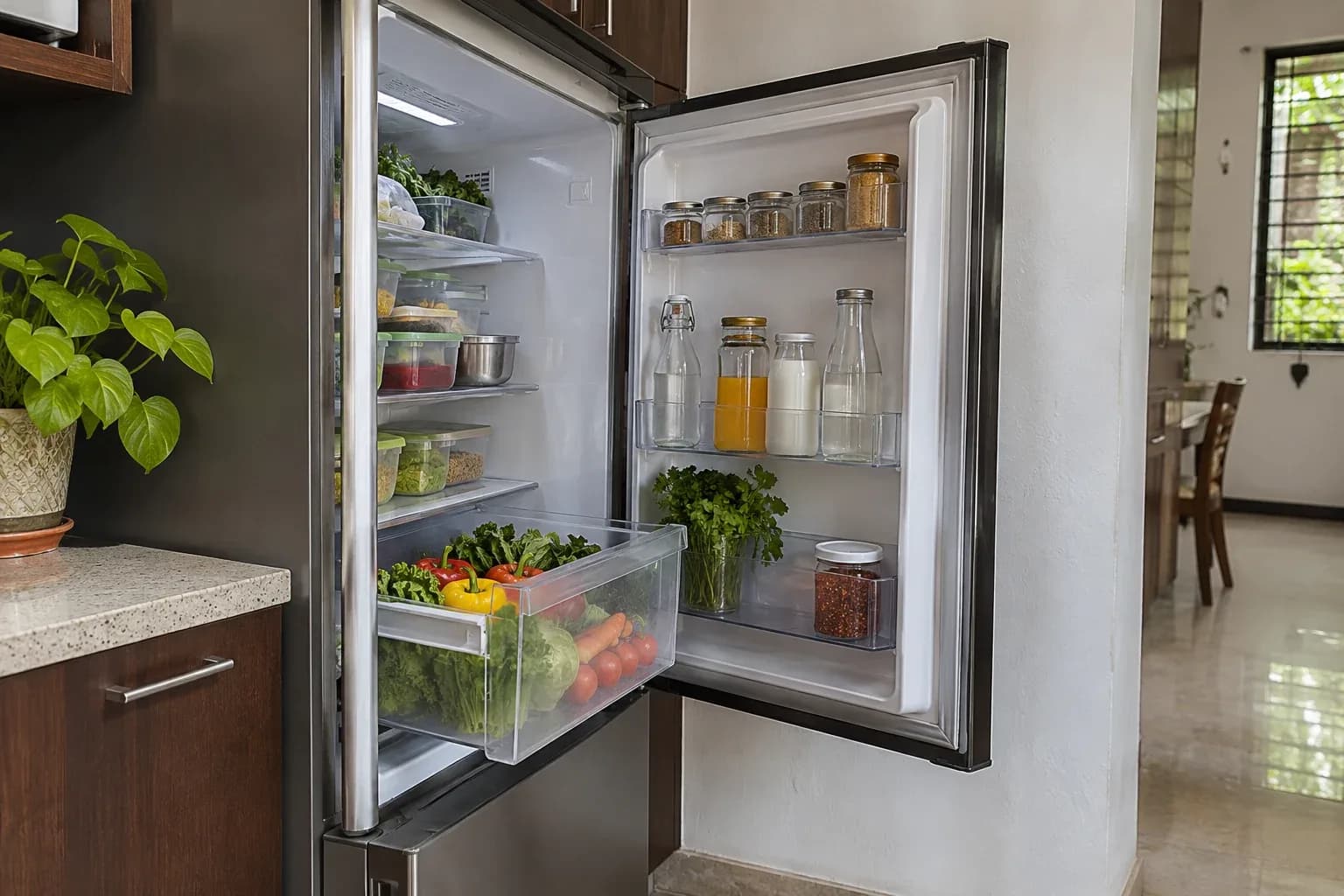
Ask to see the shelves and storage drawers removed through the available opening. Check the path of any deep drawer while the door is held at the position allowed by the room. Consider a neighbouring handle or wall that could stop the door earlier than expected. A layout that lets you reach milk at the front may still obstruct a large storage drawer or a shelf needed for cleaning.
Rehearse carrying a wide tray to the fridge from the normal preparation area. Notice whether you have to stand behind the open door or squeeze between it and another appliance.
Keep access practical after completion
Ask how the refrigerator will be moved out for servicing and how the intended electrical isolation remains accessible. Confirm the moving route across the finished floor before enclosing the appliance with cabinetry. At handover, repeat the door and drawer tests with the actual handles fitted. Keep the installation information and final recess measurements so a future replacement can be checked against the finished kitchen.
Questions people ask us
Is closed width enough to design the recess?
No. Include door swing, handles, ventilation and internal drawer access.
Can I put a refrigerator directly against a wall?
Only if the exact model's clearances and opening requirements allow it.
Does a handleless fridge avoid clearance problems?
Its hinge and door movement still need checking.
Can a filler be reduced after ordering?
Recheck every affected movement and ventilation requirement before changing it.
What if the model changes late?
Have the enclosure reviewed using the replacement's own installation drawing.