
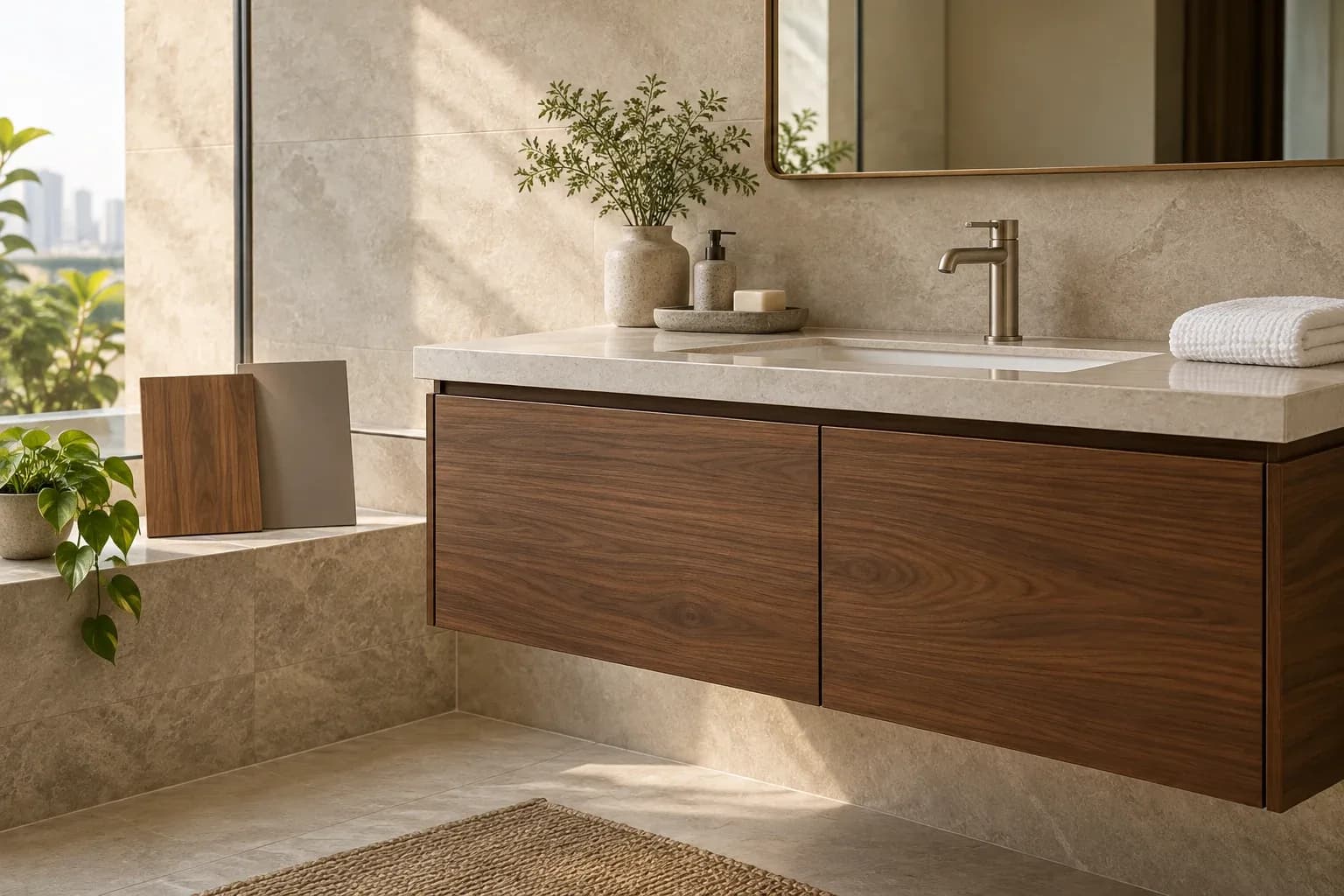
| Wood veneer | Decorative laminate | |
|---|---|---|
| Appearance | Real wood grain, with natural variation between pieces. | A specified decorative surface, available in different colours, woodgrains and textures. |
| Protection | Depends on the complete finishing system as well as the supporting board. | Depends on the selected laminate and the complete bonded panel, edges and joints. |
| Care | Use the finish supplier's cleaning guidance and dry splashes promptly. | Use the laminate supplier's cleaning guidance and dry splashes promptly. |
| Bathroom decision | Specify a finish and panel assembly suitable for the location. | Specify a laminate and panel assembly suitable for the location. |
Choose for the location, not the waterproof label
For an everyday bathroom vanity, laminate can be a practical finish to shortlist, while veneer suits a homeowner who wants real wood and is prepared to specify its protective finish carefully. Neither choice makes an ordinary cabinet immune to leaks, standing water or repeated wetting at exposed joints.
Separate three things in the quotation: the visible face, the supporting board and the details that protect the assembly. Veneer is a thin layer of real wood. Decorative laminate is a manufactured surfacing material. Both are commonly used over a supporting panel, and the condition of that panel matters even when the front still looks intact.
Consider where the cabinet will sit. A vanity outside the shower spray is different from a cabinet repeatedly splashed during bathing or floor washing. Ask the fabricator to confirm that the exact panel and finish system suit that location. If persistent direct wetting is unavoidable, reconsider the cabinet position or specify a complete system intended for those conditions instead of relying on a stronger sales description.
Inspect the edges, plumbing openings and finished surfaces
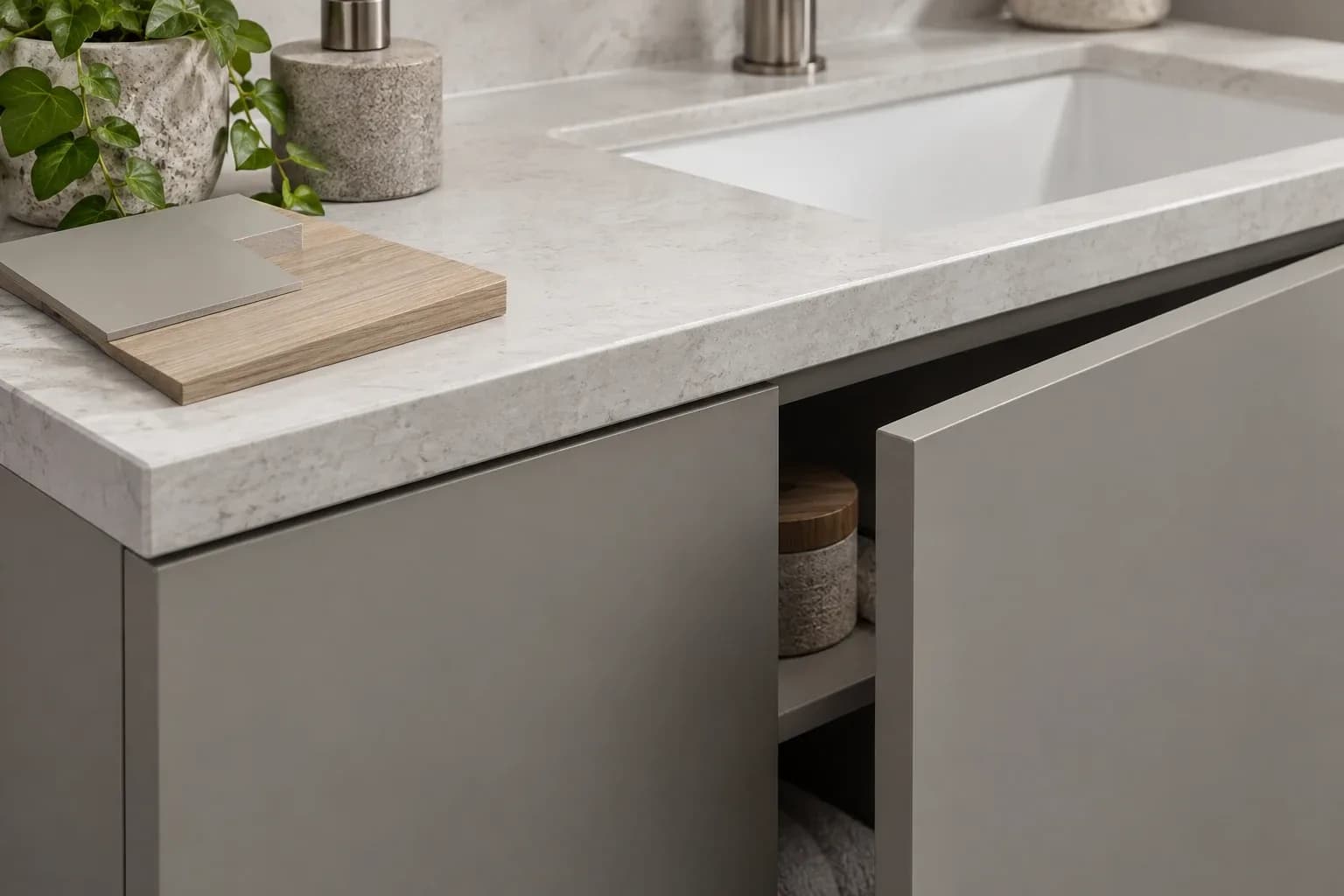
Water does not need to pass through the middle of a door face to damage a cabinet. Pay attention to edges, joints, fixing holes and plumbing cut-outs. Ask how these areas will be finished and how the basin and countertop junctions will be detailed. Include less visible surfaces inside the vanity in the discussion.
With veneer, confirm the complete protective coating system and its maintenance requirements. Decospan's technical finishing guidance explains that varnish provides a protective layer and that the coating approach depends on the product. That does not mean every clear-coated veneer is suitable for every bathroom location.
With laminate, check the precise product, adhesive and substrate specification. A moisture-resistant face should not be confused with a waterproof assembled vanity. Ask the fabricator how damaged edging or a future plumbing repair will be handled, rather than assuming the front finish protects everything behind it.
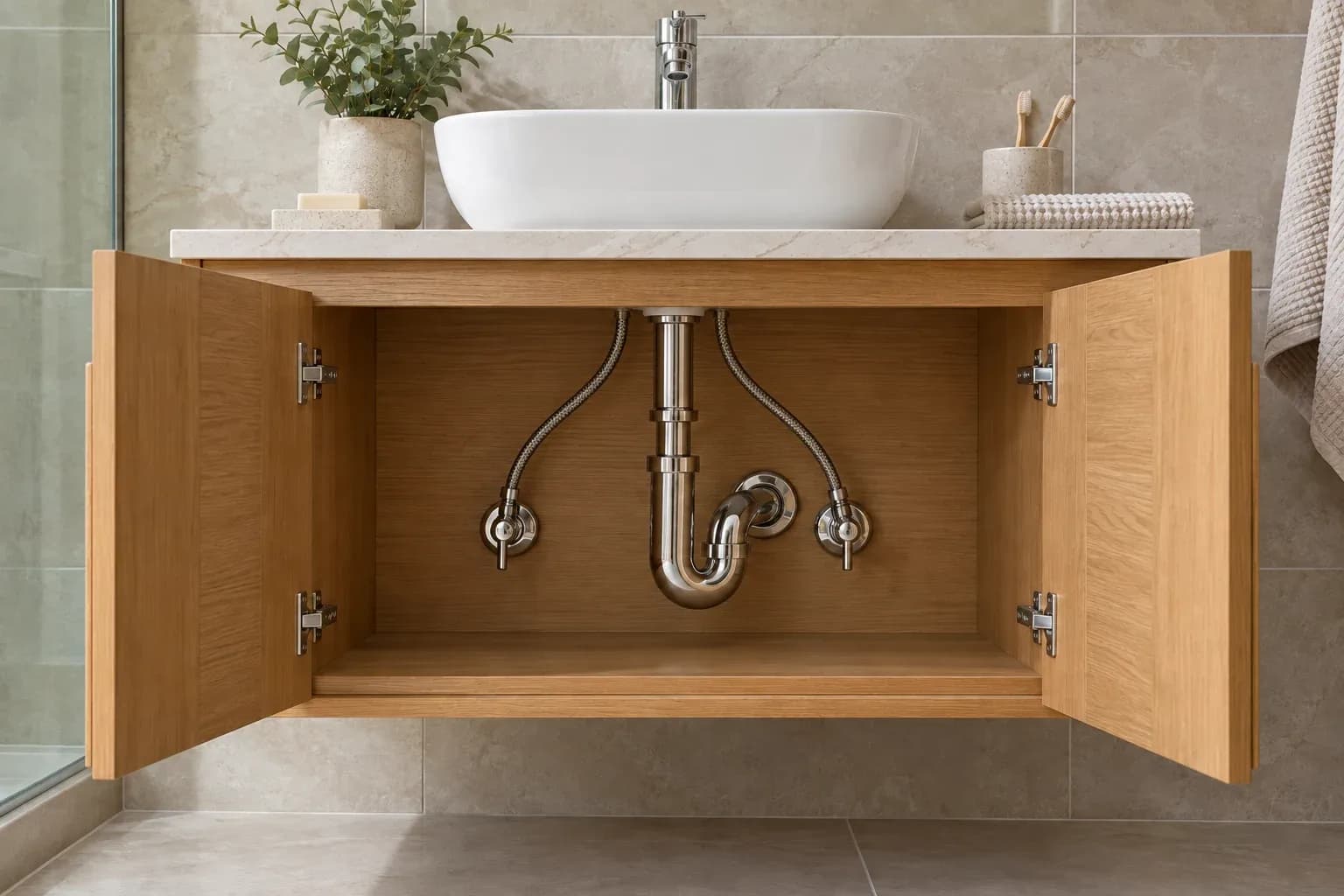
Keep plumbing connections accessible. A cabinet that hides a leak beautifully can make maintenance harder if the trap or valves cannot be reached. Before handover, have the plumber check the installation and have the cabinet installer explain access panels and any removable parts.
Compare the complete quote and the care routine
Compare like-for-like cabinet drawings, board specifications, edge details, finish systems and hardware. For veneer, include the finishing work. For laminate, include the specified laminate and bonding process. Also confirm what the installer will do around the basin, countertop and wall junctions. A price for a decorative sheet alone is not a meaningful vanity comparison.
Think about your actual routine. Wipe splashes and spills promptly, avoid leaving wet cloths against cabinet edges and follow the product-specific cleaning guidance. Do not use an abrasive cleaner or solvent simply because it works on bathroom tiles. Good ventilation and early leak detection are part of protecting the room, whatever the chosen finish.
Ask for written care instructions and retain the exact product details. If a door or cabinet base becomes swollen, soft or discoloured, investigate the moisture source before covering it or changing the visible surface. A new decorative face will not restore a damaged supporting panel.
Browse wood veneers and 1 mm decorative laminates to compare appearance, then confirm bathroom suitability for the selected products. A 1 mm sheet is a finish layer, not the cabinet board. Hinch is in Hafeezpet, Hyderabad 500085; bring the vanity drawing and explain its distance from the shower and floor-washing area.
For the general appearance and maintenance comparison, see laminate vs veneer.
Questions people ask us
Is laminate automatically waterproof?
No. The selected surface may resist moisture, but the assembled cabinet also includes a board, edges, joints and cut-outs that need appropriate specification and care.
Can wood veneer be used on a bathroom vanity?
It may be suitable when the full panel and protective finish are specified for the location. Confirm the application with the product supplier and fabricator.
Which is easier to maintain?
Compare the care guidance for the exact products. Laminate can be a practical everyday option, while veneer also requires attention to its coating system. Neither should be left persistently wet.
Does a waterproof board remove the need to finish edges?
No. Follow the complete assembly guidance. Edges, cut-outs, fixings and joints still need suitable detailing.
Can I cover a swollen vanity base with new laminate?
Find the moisture source and have the damaged panel assessed first. Covering it does not restore lost strength or resolve an ongoing leak.
What should the quote include?
Specify the cabinet drawing, board product, decorative face, reverse finish, edge treatment, coating or adhesive system, hardware and plumbing access.
Shop these categories
Keep reading
- IdeasTwo-tone kitchen cabinets: how do you choose a combination that feels balanced?
Choose one finish to carry most of the kitchen and give the second a clear place to begin and end.
- CompareFlat slab vs Shaker cabinet doors: which suits an everyday kitchen?
Choose slab doors if you want broad, uninterrupted surfaces and a quick wipe across each front. Choose Shaker if you like the shadow around a recessed panel enough to take a little extra care at its lower corners. Both styles can have handles; the profile and the opening method are separate decisions.
- CompareKitchen island vs peninsula: which layout works better in a compact home?
A peninsula earns its place when attaching one end frees up a useful passage or makes everyday seating possible. An island earns its place when people can use the routes around it, even with a stool occupied and the fridge open. Test both in your own room before deciding.
- GuidesHow do you verify plywood quality before it disappears under laminate?
Verify two different things: the identity of the material delivered and the condition of the particular pieces going into your furniture. An invoice can help with the first. It cannot explain a loose layer in the panel in front of you.
- GuidesCabinet refacing or replacement: when is keeping the old kitchen worth it?
Keep the cabinet boxes if they are dry, firm and arranged the way you cook.
- CompareFloating vs floor-standing bathroom vanity: what should decide your choice?
A floating vanity works when the wall can take the specified load and the plumbing fits behind the storage. A floor-standing unit can offer more room below the basin and conceal low pipework. Decide from a measured view of your wall and a drawer opened to its full depth.