
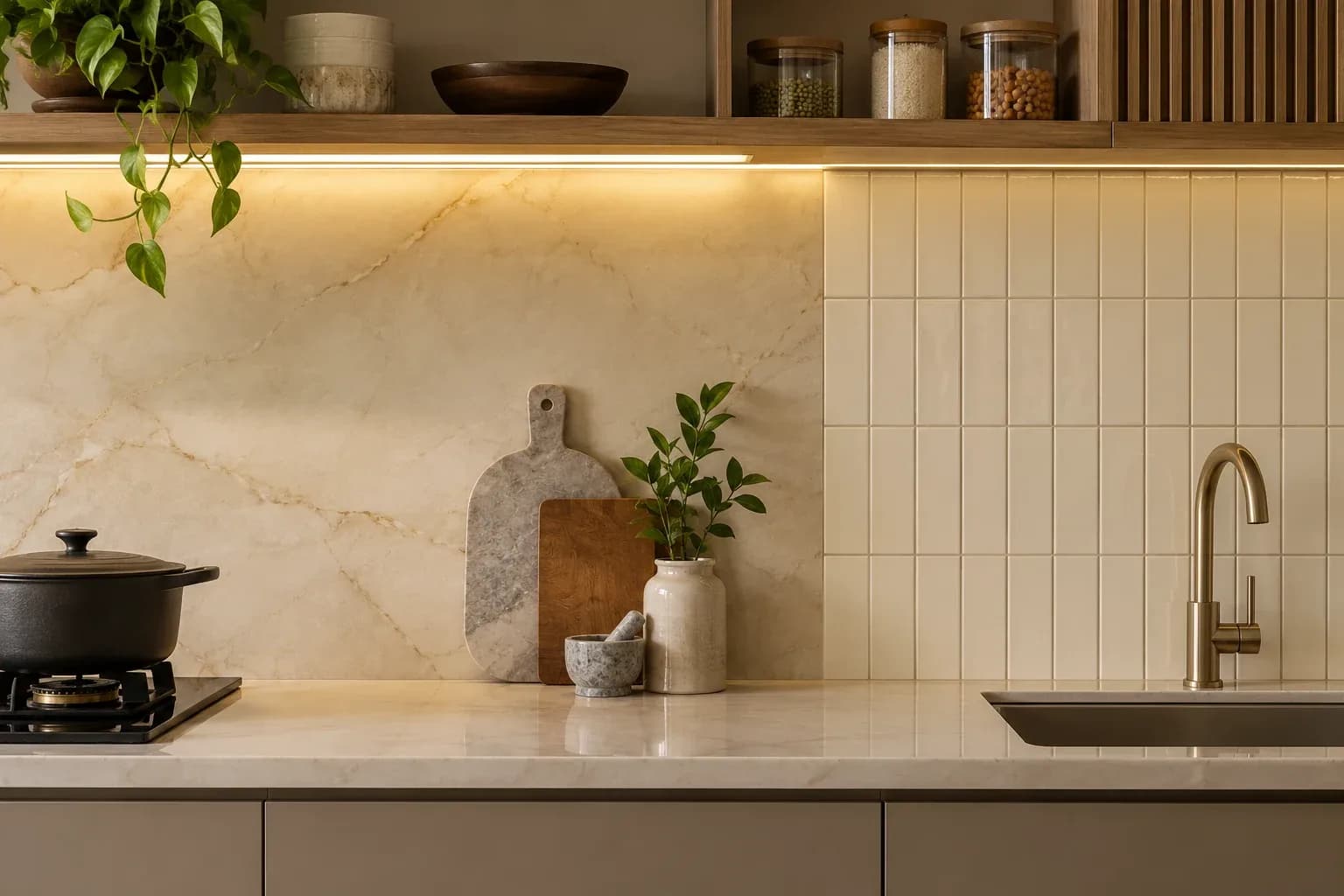
| Slab backsplash | Tile backsplash | |
|---|---|---|
| Surface joints | Fewer large-piece joints in some layouts | A grid of grout lines between units |
| Design flexibility | Large uninterrupted pattern where feasible | Flexible formats, colours and laying patterns |
| Wall preparation | Check the slab assembly requirements | Check the tile assembly requirements |
| Local repair | May involve a large piece | May use retained matching tiles |
| Price scope | Include handling, cut-outs and exposed edges | Include setting-out, trims, grout and joints |
Practical guidance
A slab backsplash reduces the number of visible surface joints, while tile offers smaller units and a wide choice of patterns. Compare cleaning, joint detailing, installation and replacement using the exact products. Neither option removes the need to plan corners, sockets and the junction above the worktop.
## Compare the surfaces you will wipe
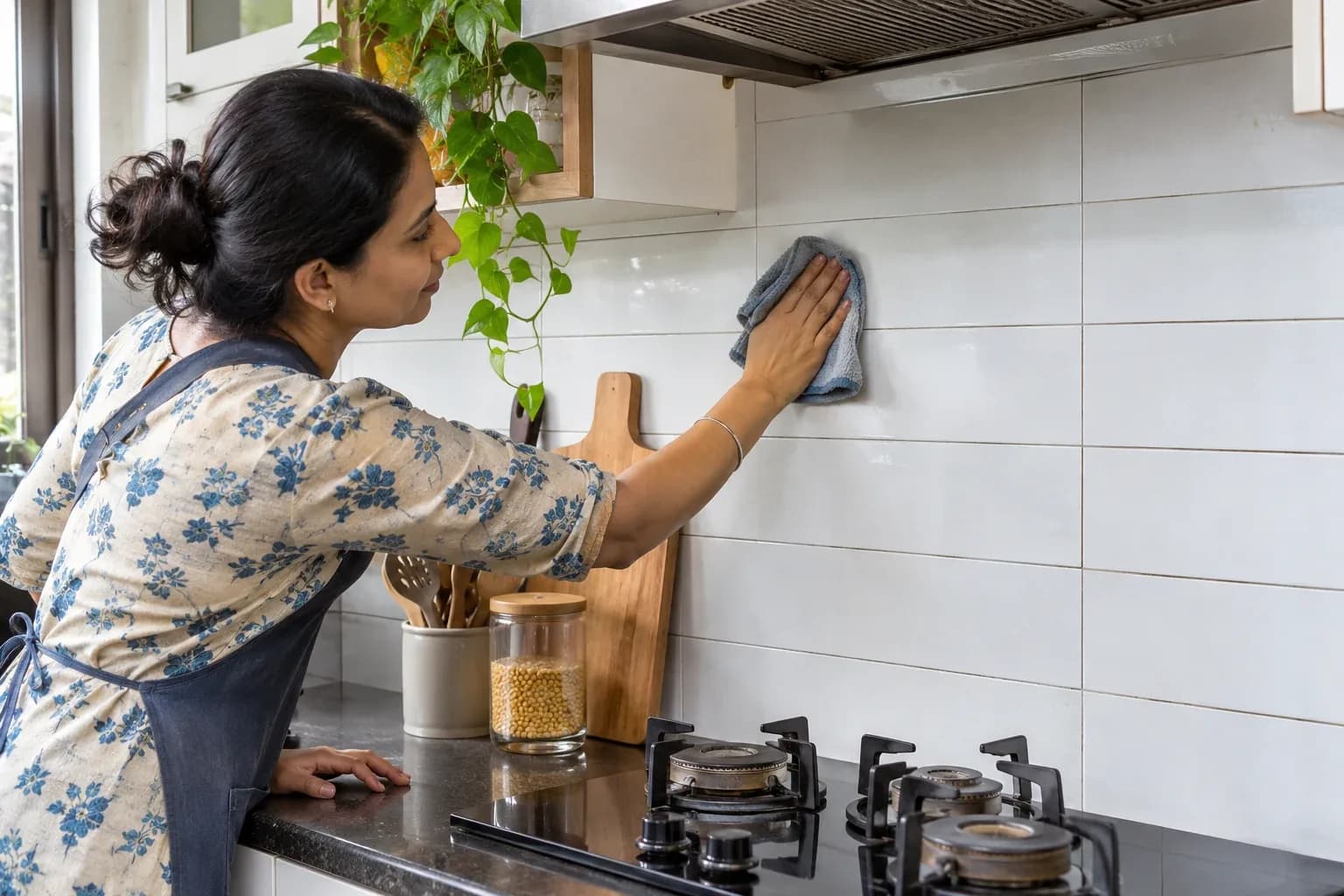
Imagine cleaning an ordinary splash beside the hob and sink. On tile, the texture, glaze, grout lines and edge details affect the task. On a slab, the surface finish and seams still matter. A smooth face can be simple to wipe, but corners and fittings remain places where residue collects.
Check the manufacturer's care guidance and any suitability requirements near the cooking appliance. The material label alone cannot establish resistance to every cleaner, stain or heat exposure. Test an allowed cleaning method on a supplied sample before choosing a demanding finish.
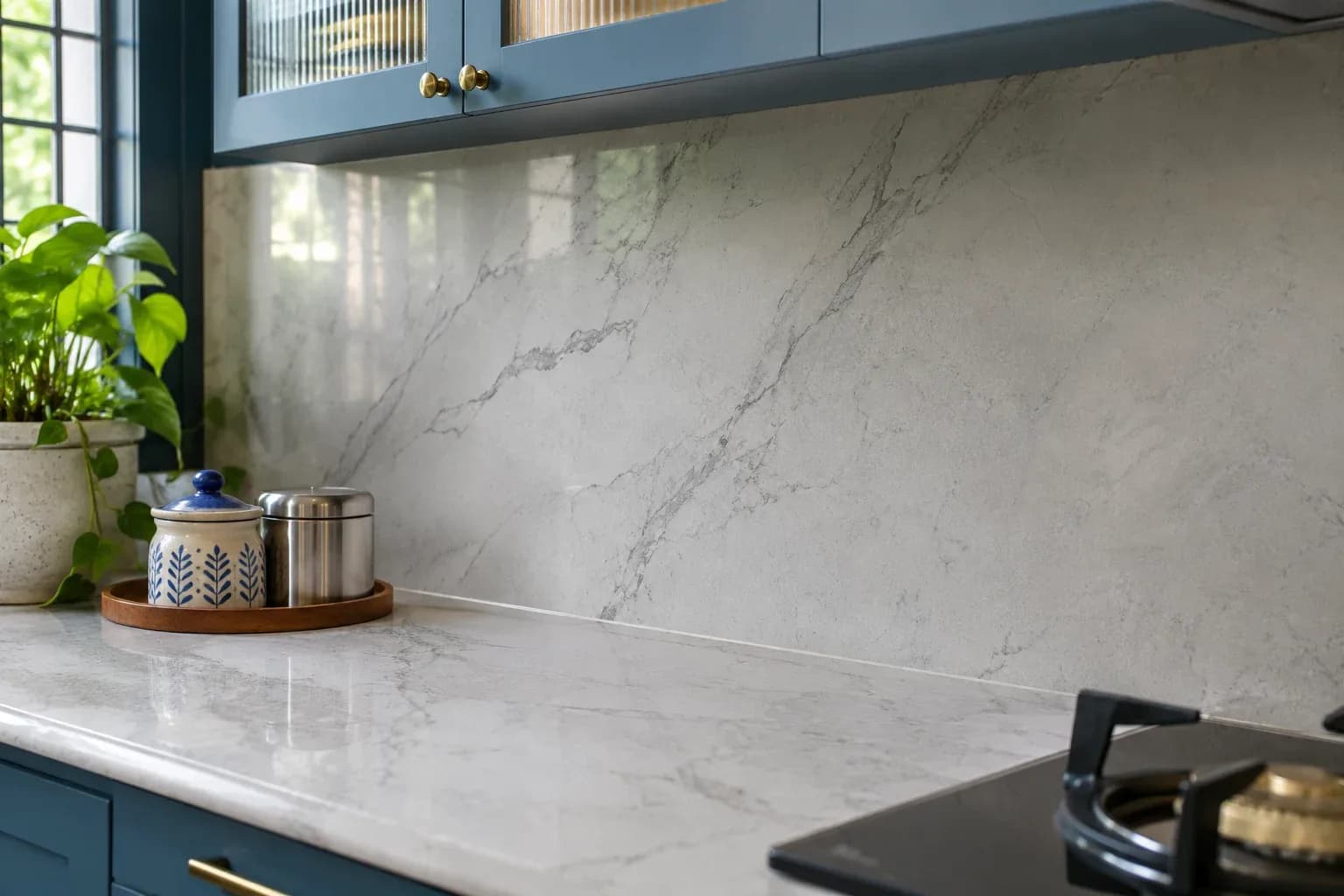
Plan the junctions before installation
Mark changes of plane, exposed ends, sockets, window returns and any interruption at the hood. Ask the installer how each will be finished. Movement joints and sealant locations should follow the selected assembly's requirements, rather than filling every junction indiscriminately with grout.
For slab work, ask about large-piece access, cutting and the wall condition required. For tile, review the setting-out around corners and outlets. A narrow sliver of tile or an awkward slab joint can be more noticeable than the overall choice between the two materials.
Consider repair and replacement
Smaller tiles may allow a local repair if matching spares are retained, although access and the substrate condition still matter. A large slab can create a more continuous surface but a damaged area may involve a larger piece. Ask the supplier how later repair would be approached.
Compare completed quotes with the same covered area and edge scope. Include wall preparation, removals, cut-outs, trims, joints and appliance coordination. Keep spare tiles or the exact slab reference where practical, and save photographs of concealed preparation before the surface is closed.
## A practical check before you decide
Draw the backsplash elevation with sockets, window edges and hood. Ask each installer to mark joints, cut pieces and exposed edges. Wipe the shortlisted samples with the permitted cleaning method and compare them under the kitchen's task lighting before approving the final layout.
## Compare the complete wall assembly
Ask both installers to describe what happens behind the visible finish. The wall condition, adhesive or fixing method, exposed ends and changes of plane belong to the installation proposal. A slab with fewer face joints still has junctions at the counter, corners and openings. Tile requires a deliberate layout as well as a suitable joint specification. Keep the responsibilities for wall preparation and final sealing clear.
Thickness matters at sockets, window returns and cabinet edges. For a product example, Silestone is listed at 12 mm, 20 mm and 30 mm by Cosentino. Confirm the section proposed for your wall; these options are not a recommendation to use any thickness with any fixing method. Ask the tile supplier for the equivalent finished build-up, including its setting materials.
## Practise the cleaning task you will repeat
Use a sample large enough to include a tile joint or a representative slab finish. Check the permitted cleaning method with the supplier before testing. Wipe from the face into a corner or edge detail and consider where cooking residue will collect. A heavily textured surface can require a different routine from a smooth one regardless of whether it comes as tile or slab.
Keep a record of the grout or sealant reference and retain matching tile spares where practical. Ask how a socket change or local damage would be repaired later. A large continuous-looking panel may require more extensive removal, while a small tile repair still depends on matching stock and the condition behind it. Choose the option whose appearance, cleaning routine and repair implications suit the household, then approve the full elevation before installation.
Questions people ask us
Is slab always easier to clean?
Its finish and junctions matter. Compare real samples and maintenance instructions.
Can grout be eliminated completely?
Even large surfaces need correctly detailed junctions and changes of plane.
Should the backsplash match the worktop?
It can, but the combined pattern and slab layout should be approved.
Do small tiles suit every kitchen?
Consider how the grout pattern and cut pieces look at full scale.
Which quotation is more useful?
One that includes preparation, all edges, cut-outs, joints and installation.