
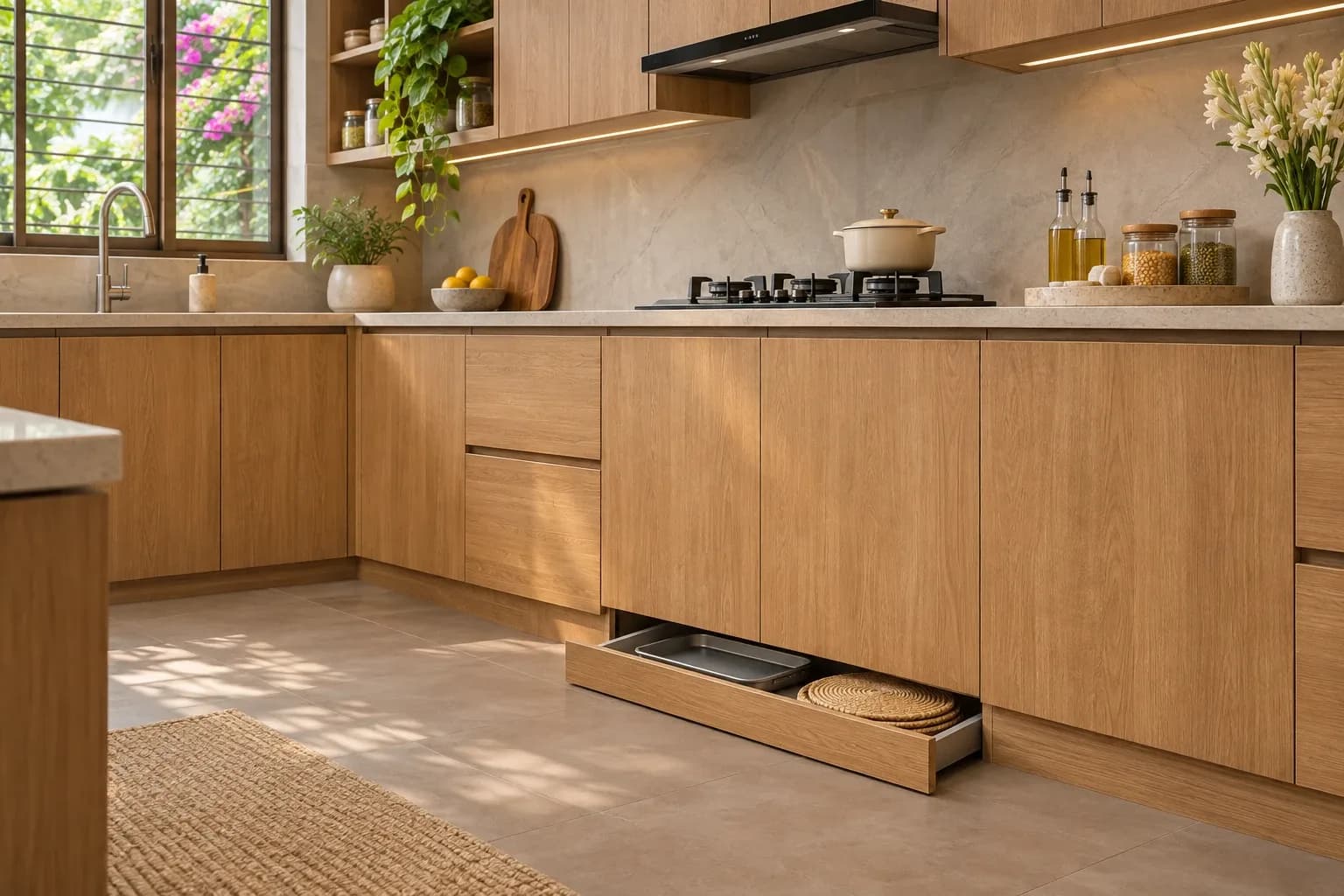
What to check before adding toe-kick storage
A toe-kick drawer uses the recess below a base cabinet for shallow storage. It earns its place when you have a specific set of flat items to store and can open the drawer comfortably from the aisle. If the cabinet legs, a dishwasher service route or a removable plinth already use that space, a conventional shallow drawer may be the better choice.
## Start with the items you want to store
Lay the intended items on a table and measure them together. Baking trays, spare placemats and flat serving boards are reasonable candidates. A tray with a raised rim or a board with a handle may need more clearance than its flat surface suggests. Check the largest item with any liner or divider you plan to add.
Think about how often you use each item. If you reach for a chopping board several times a day, try bending down to take it from a low shelf before committing to a floor-level drawer. A toe-kick drawer is often a better home for occasional-use pieces. Keep heavy cookware in a drawer that the cabinet maker has specified for the load and that you can lift from comfortably.
## Ask for the clear internal dimensions
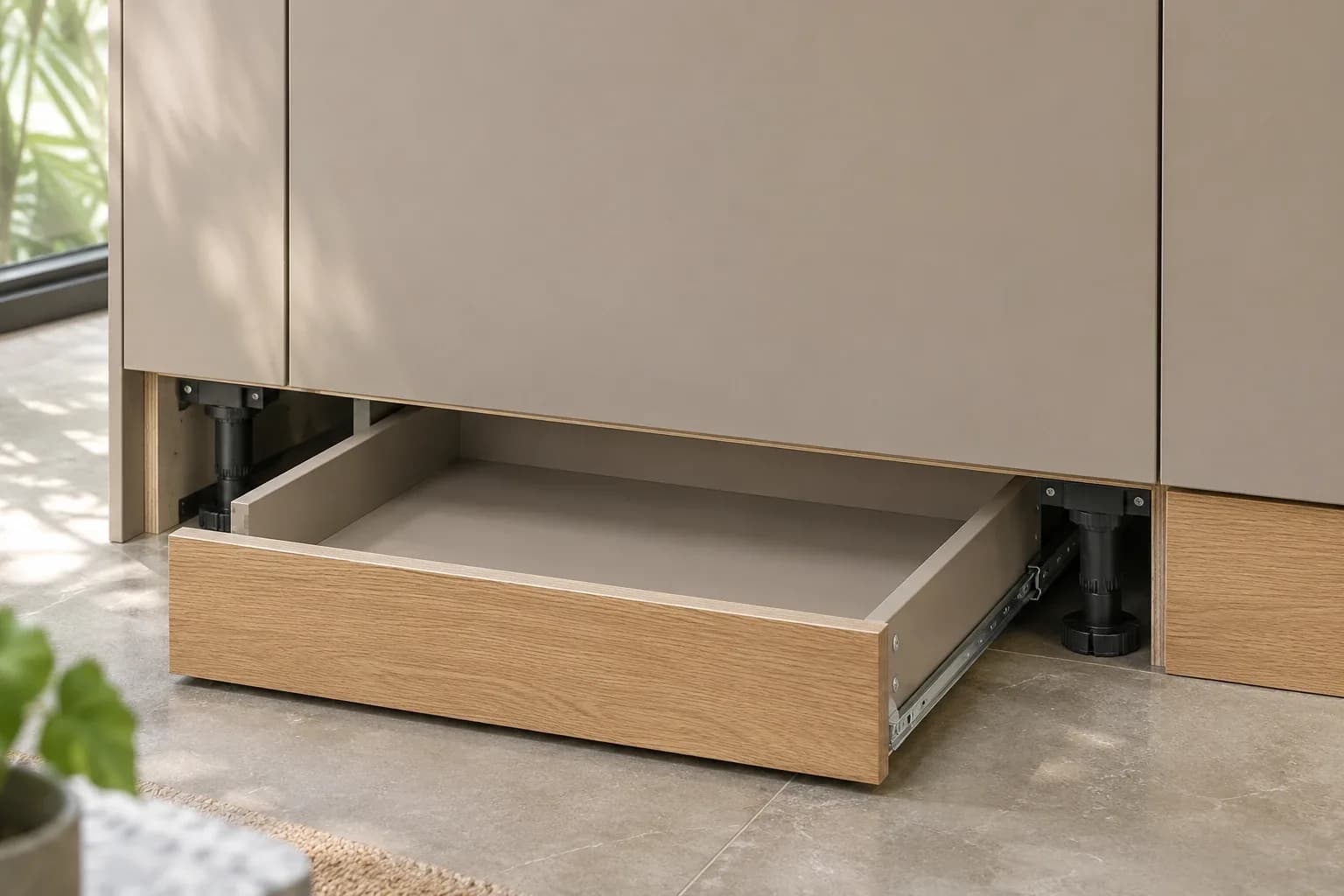
The plinth height on a kitchen elevation is the visible measurement. Ask the maker for a section showing the floor, cabinet legs, drawer box, runners and the clearance needed to open the front. Ask for the usable width, depth and height inside the box after those parts are included.
For illustration, a drawing with a 100 mm plinth and a 20 mm clearance allowance leaves 80 mm before accounting for the drawer construction and hardware. That calculation does not tell you the finished storage height. Use the actual fitting drawing, then compare the resulting dimensions with the items you measured.
On the plan, mark the legs, any floor level changes and adjacent appliance openings. A wide run can look suitable on the elevation while its internal supports divide it into smaller bays. Have the cabinet maker show the support layout before the drawer position is agreed.
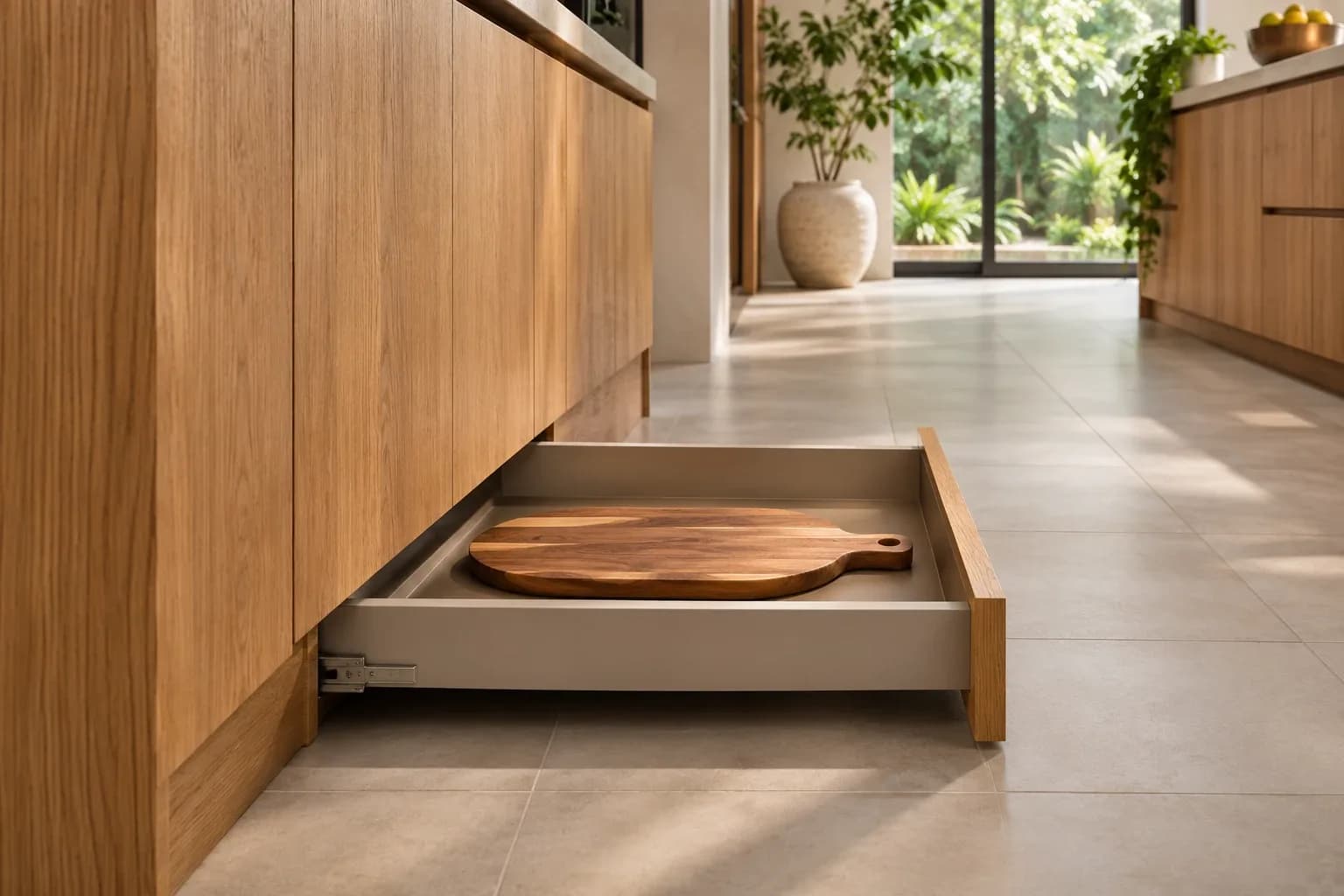
Test how it opens in the aisle
Mark the extended drawer on the floor with tape. Stand where you would normally open it and check that you can reach the contents without stepping into the dishwasher door or a busy route. In a narrow kitchen, repeat the test with the opposite drawer or cabinet door open. It may make sense to choose a quieter bay instead of using the first available space.
Ask how the drawer is released and whether the front can be adjusted after installation. If a push-to-open front is proposed, try the selected fitting on a sample. Consider whether it could be opened unintentionally while standing at the counter or cleaning the floor. Keep the opening method accessible to the people who actually use the kitchen.
Leave the plinth serviceable
Identify the bays that need access for appliance connections or removal before designing any drawer. Where the plinth has to come off, ask the installer to demonstrate how the chosen arrangement gives access. Keep that service requirement on the drawing so it carries through to fabrication and installation.
A floor-level drawer is also close to dust and splashes during mopping. Ask how you will clean around it and whether the box can be taken out for service. If a location is regularly wet or awkward to clean, leave the plinth accessible and use a higher drawer for the same items.
## Compare the fitted cost with a regular drawer
Ask for the price of the complete toe-kick assembly, including the box, fittings, matching front and installation. Compare the actual storage it adds with a tray divider in an existing drawer or a shallow drawer in the base cabinet. This makes the decision about storage you can use rather than the amount of space a sketch appears to recover.
Before approving the order, check one representative bay on the cabinet section. Confirm the items it must hold, the clear dimensions, the extended position and how it will be removed. If you cannot identify a useful load that fits those constraints, keep that bay as a simple removable plinth.
Questions people ask us
Can I add a toe-kick drawer to a finished kitchen?
Sometimes. Have the fitter inspect the existing cabinet legs, available height and removable plinth before ordering a retrofit.
What fits in a shallow plinth drawer?
Measure flat pieces such as baking trays, placemats and spare serving boards. Check handles and raised rims against the usable height.
Can I fit one below a dishwasher?
Check the appliance instructions and removal route with the installer before deciding whether that bay can accommodate a drawer.
Do toe-kick drawers need a push-to-open fitting?
The opening method depends on the cabinet design. Try the chosen fitting on a sample and check that the front can be operated from the aisle.
When is a conventional drawer the better choice?
Use a higher drawer if you need frequent access, the items are heavy, or the floor-level space is needed for services or cleaning.